Showing posts with label essaying. Show all posts

Friday, December 26, 2008

The snow always shines on TV

Earlier this month as the holiday season came upon us, I was chatting with my dean about favorite holiday flicks; my head currently embroiled in Ernst Lubitsch films, I mentioned The Shop Around the Corner as a favorite. "For me," she said, "I love nothing better than the hokey wonderland that is White Christmas. I just love that film."

"If you can believe this," I said, "I've never seen it."

Her jaw dropped. Indeed, somehow I have never managed to catch Bing, Danny, Rosemary and Vera-Ellen do their post-WW2 tinsel-wrapped spectacle in any form (television, video or otherwise). I have no idea why I missed this, since I'm a sucker for everything that the movie stands for: musicals, Bing Crosby crooning, implausibly mild Vermont winters, etc. My dean (who is not a film expert, mind you) was genuinely upset that I had not seen this; within two days, a DVD copy that had been lying around her house appeared in my departmental mailbox. The end-of-semester grading mayhem quickly commenced, however, and I didn't get to watching it, despite her constant cajoling in the hallways, until a few days before Christmas, with my parents in town and a cold wind blowing outside.

Since I'm still ovewhelmed by holiday cooking, I'll say that my first response is that White Christmas is something like a meringue: a light, fluffy, pretty confection that isn't very filling. I was stunned to find that a drag routine done by two of the most popular jocks in my Peruvian high school was lifted verbatim from this movie (costumes and all!); I was less stunned to discover that Donald O'Connor was originally slated to do Danny Kaye's part, given its similarity to his role in Singin' in the Rain.

I decided to post about the movie after reading a holiday posting by Glenn Kenny on the film, mainly because one particular aspect piqued my professional curiosity and has stuck with me. The plot finds Bing Crosby and Danny Kaye up in Vermont at Christmastime, where their beloved general has fallen on hard time following the War while running an inn; to cheer him up, the boys decide to ask all the members of their infantry who live in New England to come to Vermont for a surprise. In order get them there quickly, however, Bing decides to go to New York and appear on the Ed Harrison television show (Harrison also being a fellow infantryman, coincidentally enough) to encourage them to come. Everyone watches this show, including the general (Kaye must fake a knee injury to get the general out of the room from where the television set is located) and Rosemary Clooney, who watches backstage from the nightclub act that she is doing in New York when she mistakenly thinks Bing is using the general's plight for cash.


This use of television fascinates me and I want to investigate it more. For one thing, using television as part of the plot seems to run counter to the entire point of the movie in the first place, since the film was known and marketed at the time for being the first to be filmed in Vistavision, Paramount's entry into the widescreen market. From what I understand (and it's been a while since I've read Bolton's book on widescreen), this technological innovation was meant to combat the encroachment of television into the entertainment market. (Drive-in theaters and 3D also were technological innovations, but widescreen is the most interesting to me). It is therefore somewhat surprising for me to see a television screen within a wide theatrical screen. From an international perspective, this might have been the first time that some countries would have seen televisions and how they might be used; according to this, television didn't arrive in Peru until 1958, and this movie was released four years earlier and was undoubtedly screened there. So what was the general reaction to seeing television in this film? And what about in the United States? Why did Paramount choose to include the use of television as part of the plot, when the movie industry was trying to combat television? How many other movies in the 1950s did this? What kind of relationship between TV and movies existed for this?

We'll see. Give me your thoughts, if you want, and let's see what happens.

Sunday, September 28, 2008

Raising my bottle of vinaigrette

Oddly enough, one of my favorite Newman clips remains this screen test for East of Eden:


Naturally, I think this in part because James Dean is in it and everyone knows how I swoon for Jimmy. (Note: Giant played on PBS tonight. All kinds of good.) But man, this is so wonderful in part because Dean and Newman are so wonderfully different. Dean is clearly taunting the boy with the bowtie in a very sexual way -- and I don't say that just because he says, "Kiss me." The mutual stare at the end almost looks like they will either come to blows or make out. Either way might have worked for the film.

The funny thing, of course, is that it's arguable that Newman got his big break because of Dean's untimely, pointless death. His role as Rocky Robert Wise's Somebody Up There Likes Me broke Newman out of pretty-boy roles on television and into film and, quite frankly, the movies were never quite the same (or at least the leading men). As much as I am a Dean fanatic, I'm fairly certain that, like his idol Brando, he would have burned out or became large and eccentric had he survived. At the very least, he would never have had the career that Newman did -- or, indeed, the life that Newman did. The clip above is a funny reminder of how two stars diverged so very much from this point on -- and yet how both have gone down in infamy glow brightly, only in our collective memory.

Thank you, Paul.

Saturday, August 23, 2008

CAMERA


CAMERA
D: David Cronenberg, Canada, 2000, approx. 7 minutes.
Source: Viderdrome (Criterion Collection version)

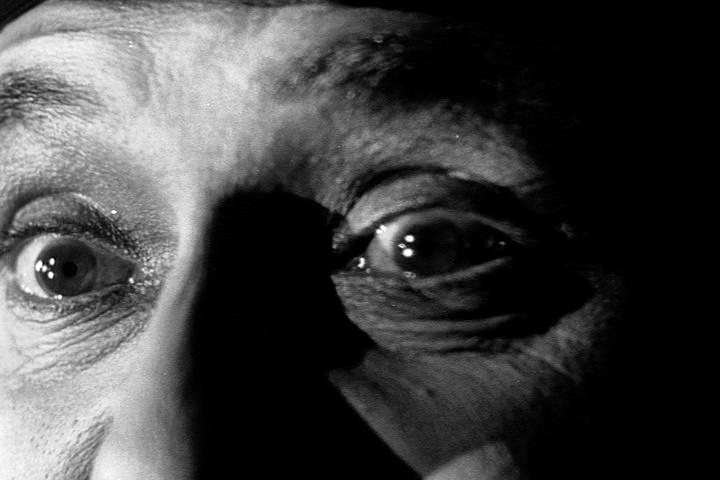
A narrator starts to tell a story off-camera: "One day, the children brought home a camera." It's a simple statement; it starts simply, with a man -- no, not a man: an actor. Images of the children with the camera are intercut with images of a nice gentleman with graying hair, shot with a video camera in medium shot. As he continues, however, the (video) camera starts to push forward, so that the man is in close-up when he announces something unexpected: "When you look at it in a cold light, photography is death."

Camera continues a fascinating interplay of images as the actor delivers a monologue about the "dangers" that the Camera proposes. The children matter-of-factly do all the tasks needed to make a movie: check lights, process film, measure the f-stop; these are all shot in a very matter-of-fact manner as well, with relatively "normal" lighting and camera distances. These are all in stark contrast to the images of the actor, who the video camera moves into shots so close that we as viewers feel uncomfortable. The actor appears unattractive, even sinister: the light from the windows appears too harsh, his eyebrows are thick and menacing. The actor is also edited in an odd manner: often, we are presented with jump cuts to sudden extreme close-ups of his eyes. The images are not necessarily horrific, yet the tone established throughout this piece is horrific.

In many ways, Camera is an interesting precursor to Cronenberg's 2005 feature film A History of Violence, which cannily comments on the movies in a similar way. In that film, scenes of violence and gore which would otherwise titillate the viewer are presented in a stark, cold manner than unnerves even the most seasoned viewers, making us question the very nature of the horror film genre. (One can argue he this is a common preoccupation for the director, also seen in eXistenZ, Naked Lunch and especially the brilliant Videodrome, which also featured Leslie Carlson, the actor featured here.) In Camera, Cronenberg does not present any gore and yet the whole film is structured to terrify. I particularly like this piece because the link between photography and death so clearly derives from Roland Barthes' tragically final work Camera Lucida. These ideas were not academic for Barthes: the work is inspired by his mother's death, and every photograph of her does not remind him of the joy that her life brought, but instead serves to mock him, reminding him that she is dead. Cronenberg highlights something very similar: the life captured by motion pictures only demonstrates that such moments cannot be repeated and taunt us with what once was and can never be again.

Camera becomes truly haunting in the last minute or so, when the children bring the large, old 35mm camera into the room with the actor. They apply make-up, change everything around and then a young boy (bespectacled, like Cronenberg) says, "Action." And suddenly, the image changes: it is warm, gorgeous, widescreen. And suddenly we realize that the harshness of everything that has come before is largely due to the use of video instead of film. (This section was actually filmed with the very camera seen throughout the short.) And yet, as soft and beautiful as this looks/sounds/feels, we are acutely aware of everything that the actor has noted before this. He repeats his initial line -- "One day, the children brought home a camera" -- but the line is changed, no longer innocent. And this time, the shot hangs on just a little too long. It catches the actor's face in a private moment: in the last seconds of the film, Carlson's face breaks for just a moment, his eyes watering and distant, filled with despair. The film cuts away to black -- and the effect is terrifying. Can we watch movies again the same way?

This entry is part of the Movies About Movies Blogathon hosted at GoatDogBlog -- please feel free to visit the other entries listed on that site. This is also cross-posted as the first entry at the newest incarnation of The Short Films Blog, the blog associated with my course this semester. New entries on short films will appear every day until December 11th, with students starting to post next weekend. Please visit there often -- and comment on the students' work, since they earn extra credit for more comments!

Tuesday, November 21, 2006

I needed you, Robert Altman

I was driving this afternoon by Ward Circle, having listened to Terry Gross' great interview with Parker Posey and on my way in to pick up my stack of papers to grade. It promises to be a cinematic weekend indeed, what with fifty mini-tomes on González Iñárritu's Babel. But then Terry Gross announced, "Coming up next, we take a look back at the life of Robert Altman, who died last night at the age of 81" and I cried out, almost stopping the car in the middle of the circle.

One thing is to appreciate a director and his work and, as a film scholar, I dutifully venerate Altman as the auteur he is. If nothing else, I use his films every semester to teach how sound can be used to focus attention on the screen instead of the camera, a technique he basically pioneered.

Perhaps more than any other contemporary director, however, Altman's work has connected with me on a personal level for quite a long time. One of my best students during my current tenure at AU wrote a fantastic piece in my course on the musical extolling the virtues of Nashville, brilliant enough that I was convinced to include it the next time I taught the course. My own interest in genre (and indeed of higher film study in general) started largely because of a paper I wrote in graduate school on the fascinating anti-Western McCabe and Mrs. Miller, a movie that still takes my breath away. I remember wrapping up an evening of chatting about pedagogy with my very first mentor, Julie Kalish (who laid the foundation for everything I know about teaching), by our going to see Short Cuts, still one of my favorite films. (The closing credits started to roll and, after three hours, Julie and I were mystified that there wasn't more movie to watch.) M*A*S*H; Three Women; Gosford Park; The Long Goodbye; Come Back to the Five and Dime, Jimmy Dean, Jimmy Dean: the list goes on and even when Altman failed (such as in the steaming pile that is Pret-a-Porter), he failed impressively.

It is even arguable that I would not be where I am today without Altman. As a senior in college, I wrote a paper bringing together reactions of Willa Cather's A Lost Lady and Altman's just-released ransom note to Hollywood, The Player. I was intrigued that both texts garnered the same responses from my peers: thrill for most of it, only to be met with disappointment at the end when the anti-hero triumphed instead of receiving a come-uppance. In clearing my paper topic, Professor Jahner (who I later realized I wanted to emulate when I would become a professor) laughed and said, "I don't know what you're talking about, but you seem more than fascinated by this movie. Go for it and see what happens." I was so proud of this paper that I submitted it as my writing sample to get into graduate school -- and sure enough, it got me into Michigan.

But my relation to Altman goes even further than that.

You see, my first memory of having a cinematic experience involves an Altman film.

Surely, I had been to the movies before 1980; I have a vague recollection of having seen Star Wars like everyone else on its release in 1977, and Grease and Xanadu came out before then as well, fueling my obsession with Olivia Newton-John. But the first visceral joy of going to the movies? That belongs to 1980's Popeye.

I didn't get to go to the movies too often as I was growing up. We really didn't have the money to spend on anything in those days, so I spent most of my time in the backyard. (This is fine for a kid, by the way. My own son is growing up like this.) Going to the movies, like going out to eat, was therefore a big deal. I distinctly remember one day my parents were fighting about something and Mom got really angry. She grabbed my hand, marched me to the car and started driving. "Come on," she said, "we're going to the movies." "We are?!" I said, incredulous and thrilled. I don't even think I knew what we were seeing, but I was 8 and any movie would be fine by me. And, truth be told, I loved this movie. I watched the Popeye cartoons all the time before school, and the funny guy with the puffy forearms (some guy named Robin Williams) was just great. There was a certain joy in seeing the lunacy of the cartoon come to life, not to mention that Shelley Duvall looked exactly like Olive Oyl. (Eerie.) I remember watching the movie at the Baldwin Twin Cinema on Grand Avenue with a bag of popcorn, aware of my mother steaming in the seat next to me, but calming down and eventually laughing through her tears. By the end of the movie, everything was OK, we went home -- and, in my 8-year-old way, I learned that the movies have a curious and magical power.

Popeye is today considered one of Altman's worst films: a commercial flop and the last straw that sent him careening away from Hollywood forever. Years later, when I discovered who "Altman!" was, a name to be venerated in hushed tones amongst fellow film snobs, I was tickled to find that he had directed this. I haven't seen it since back then (except the ending, which I caught once as the movie was finishing on cable) and I wonder if, like Xanadu, the film will age so badly that I will now find it laughable. I doubt it. Even so, the memory of that first truly cinematic experience will remain -- and for that alone, Robert Altman, I thank you more than I can possibly express.


Shelley Duvall, needing Robert.
If you're looking for more tributes, check out this rather comprehensive list at GreenCine.

Sunday, October 29, 2006

Drácula sounds much better with an accent (Vampire Blog-a-Thon)

Those eyes: terrible, desperate, yet exhilerating. They are haunted, haunting. And yet you can see how those eyes can hold you in their power, in their venerable thrall. The eyes of Dracula.

Well, not quite. They are, rather, the eyes of Drácula. Don't forget that accent; in Spanish, that would be a spelling mistake.

The coming of sound caused many problems for Hollywood in the late 1920s, but one of the biggest involved all those movie-goers south of the border: the exceptionally large Latin American market. Starting in 1930, Universal attempted to reach out to these patrons by filming many of their established hits with the same scripts now acted out by Spanish-speaking actors. (Indeed, the "Mexican spitfire" Lupe Vélez largely became a star through her lead roles in both the English and Spanish versions of 1930's East Is West and 1931's Resurrection.)

Only a handful of these films were made before 1931, but the most famous -- and certainly the only one of these films that is widely available -- is the curious case of Drácula. The Spanish version is largely the result of a cost-cutting measure executed by producer Carl Laemmle, Jr. to literally make two films at once: the English version, directed by Freaks auteur Tod Browning, would film in the daytime while the Spanish version, directed by George Melford (The Shiek), would film using the same script and sets that night. The Browning version catapulted star Bela Lugosi to international fame and is today considered a classic on its own terms.

Don't get me wrong: Lugosi's singular stare is the stuff made of legends and the man's debonaire interpretation of the Vampire-to-end-all-vampires is brilliant. As a movie, however, Drácula is far better.

I just finished watching both films at the same time, one on my television and the other on my computer and while both feature relatively similar scripts, the two are strikingly different. Lupita Tovar -- who plays "Eva" (not "Mina") and provides an introduction for the film for the recently produced multi-disc package done by Universal -- indicates that the actors even had the same blocking marks at night as the daytime English cast, but that means little when the camera is set up in a different place or is doing something very different. For example, one of the iconic shots of Lugosi comes early in the film when the camera slowly tracks into a close-up of Dracula's face, eyes highlighted by a band of very bright light. This happens to be the first time that we see him and it's a very effective shot. The Spanish version introduces Carlos Villarías simikarly but with no moving camerañ Melford saves it instead for an extremely impressive shot on the staircase when Renfield (played frenetically by Pablo Álvarez Rubio) sees him for the first time. Browning creeps us out with his magnificent moving shot -- but Melford puts us into Renfield's shoes in a far more effective manner by giving us a far more dynamic shot (shown here) when the narrative deserves it, not just because we should ooh and aah. In many ways, Drácula is also far more human than Dracula. Oddly enough, this is partially due to Villarías' hands, which are significantly smaller than the craws that Lugosi bends into shape. Mostly, however, the effect seems to come from how Melford frames Drácula and Renfield together as they interact rather than isolating them in individual (and isolating) shots.

But what about Eva? Ahh, here is where the real difference lies in the two pictures: the treatment of the woman. For all that she does in the English version, Helen Chandler plays Mina as cold and aristocratic, like most female roles of the time. In Stoker's novel, however, Dracula is far more sexual and the fact that mostly women fall under his thrall implies a certain explicit sexuality which is only implied in Browning's film.

Not so Melford's version. Freed from the binds of the fledgling Production Code, Melford was able to show much more of what Drácula does to Eva and, even if he doesn't show all-out sex, the evidence is far clearer. For one thing, the Melford version actually shows the bite marks as evidence to the viewer, something denied in the Browning version. And please: look at these images here. First, Eva is drawn to Drácula in the night. Helen Chandler would not be wearing the shapely, sheer dress with which Lupita Tovar saunters saucily onto the screen. Even from far away, we can see why Drácula wants her, not to mention what he wants her for. Of course, the implication here is that Eva wants it, too. This shot culminates, by the way, in Drácula lifting his cape and Eva coming under his wing, which he clearly brings down in order to "kiss" her on the neck. Yes, there is a lot of Eva-kissing in this film -- on the hand, on the neck, kiss-kiss everywhere. (Poor Mina never gets to have any fun in Browning's film.)

And just look at her after Drácula has finally had his way with her! Yowza. Doesn't she look like she's about to start singing "I Feel Pretty"? That's because she got some Drác blood in her! Tovar plays Eva in a far more carefree manner than Chandler throughout the film, but the looser attitude really comes across here with the plunging neckline, the loose devil-may-(literally)-care hair and a stance that says "I'm a WOMAN now!!" Her fiancé, Juan, says, "I can hardly believe it! You're a different woman now!" Guess what, bucko: she is. Maybe you should have gotten to her first. By showing us some of these scenes, Melford's version of the Stoker tale not only stays faithful to the novel with its implied sexual tension, but also simply makes much more sense. Give me Lupita Tovar any day... but only if she bites.

This posting is part of the 2006 Vampire Blog-a-Thon, featuring over 40 other blogs all talking about vampire movies. Thanks to Nathaniel at The Film Experience for putting forth the idea! Check this page for information on all the other blogs, although I particularly like these:
Oh yeah -- and Happy Halloween!

Tuesday, September 12, 2006

Diary of a Montgomery County Election Judge

In 2004, I answered a call sent out on a public radio PSA that was asking for bilingual-Spanish people to work as election judges. I was assigned outside my own district to Pine Crest Elementary School in the Four Corners area of Silver Spring. During that presidential election, I assisted only about three votes out of nearly a thousand with Spanish, but did pretty well with helping voters use new touch-screens. The Republican Chief Judge (a really nice guy) suggested that I apply to be Chief myself for the next election. So earlier this year, when the Democrat recruiter begged me to be a Chief for the same school, I said yes. What could possibly go wrong?

Hoo.

I should note before I go on that I have been up since 5:00AM. Tomorrow, I have to wake up with my son no matter what (because he could care less what I did today, he wants to play), take him for a doctor's visit (avec les shots), then race to campus to catch a post-screening discussion for one class, followed by a block class for which I am quite underprepared. All that said, I feel compelled to write this, and to do it right away. (Marcy, Jenny: This is especially for both of you.)

To start with, if you're reading this, you should know that on Monday night, I met with all my poll-workers to set up as much as we could before the morning rush. We set up the actual touch-machine polls on their legs, hung up some signs, coordinated what we would do with meals and when. You should also know that most items immediately applicable to the election cannot be opened the night before: the machines themselves, bags contained secured voting items, etc. All these items have tamper tape and locks and what-not to ensure lack of fraud. (We will not go into the Diebold issue, which is separate from what happened today. Yes, these are Diebold machines.) The crew seemed apt and congenial and G (my Republican counterpart, a lovely retired woman) and I both were confident we would be OK. Neither one of us had been a Chief before, but we had some good vibes. My main concern was that I still had to go home after set-up to (a) review my notes for the election and (b) make a curried lentil dip for my fellow election judges that I had already bought ingredients for.

We all arrived at 6:00AM as scheduled. Actually, G arrived about 5 minutes late. No big deal, except she had the bags with the keys and what-not. Everyone started doing what they were supposed to be doing with set-up. I opened the bag with all the secured equipment to get the keys and to get the plastic Voter Assistance Cards that would allow each voter to vote. (As a voter, you need to first have the card encoded with the proper primary election, then you are allowed to vote on the machines.)

No cards.

My first thought was: We must have dropped them somewhere when we opened the bag.

We searched the bag again, the table that the bag had been placed on, other secured bags. We thought about checking G's car for another bag, even though she insisted she had brought all the bags and besides, by law, once we were in the polling place, we weren't supposed to leave. We checked our handbooks for the excruciantingly inclusive checklist of items ("8 pencils"), trying to figure out where the bags were supposed to be.

I thought: No. There is no way they would have forgotten to pack all of the single item that people actually needed to vote with.

We call the hotline. I get put on hold for a while, tell everyone else to do what they can do to get ready. Someone finally answers. I tell them we have no VAC cards. The man says that they are aware of the problem.

For a split second, I try not to faint.

They continue to tell us that they are on their way with the cards, but that if they don't arrive in time, we need to prepare to do provisional voting.

More explanation: provisional voting usually occurs when there is a discrepancy between what is in the log book and what a voter says is true -- for example, party affiliation doesn't match, or they just moved from another part of the state, or they got married and their name changed, but none of these changes are yet in the pollbook. If this occurs, the voter fills out some forms at the Assistant Chiefs' table and is then given a paper ballot; after they fill that out, they seal the ballot in a special envelope and drop it in a big bag. This shouldn't happen very often, but it can be a somewhat lengthy process. Indeed, at 6AM, I had joked to the Assistant Chiefs (E and M, hereafter referred as a pair as ACs) that they were the ones who would be lounging around all day.

I hang up and relay the information to all the staff. Everyone's mouths drop open: they forgot the VAC cards??I warn the ACs to prepare for the worst. We are confident that they will get the cards to us before we open. We start all the machines up as usual.

Mind you, once again, it should be remembered that once we go into the polling area, we are sealed off from the world. No one can call us, there is no news, no radio, nada. We had no idea that this was happening practically all over the county. Because, who would forget such an important item in EVERYONE'S PACKETS?

At around 6:50, we realize that the VACs probably aren't going to arrive. G and I (OK, I...) decide that we have to open on time, that there were people there to vote and they needed to vote. And that we would do it provisionally.

At some point during all of this, our student arrives. Montgomery County offers community service credit to students who work a four-hour shift at the polls doing unobtrusive stuff like handing out stickers or making sure people don't walk away with the expensive VACs. I sit Mary down and tell her that we have a different job for her. We explain what's going on and then tell her that her job will be to inform everyone outside what is going on: that we will be voting on provisional ballots until the VACs arrive (which they should at any minute) and, because of the paperwork involved, that the process would be relatively slow. They could wait in line or, if they had to go to work or wanted to vote on the machines, to come back later; no matter what, their vote would be counted. (Bless your heart, Mary: she had potentially the most crucial job today and she performed it flawlessly.)

We open at 7:00AM. On time.

G and I quickly inform all the voters of the situation, but that we will continue voting provisionally until the cards arrive, which should be at any minute. I then call again to ask if they knew where the cards were.

A word now about G: she is a wonderful woman, and a real trooper for agreeing to be the Chief. She's also retired and, frankly, can get a little frazzled. She had already confessed to me when we first met (days ago, when we checked out the school space before the election) that she thought she was in over her head; I assured her that us newbies would be fine. That woman is fabulous for letting me drag her along with everything I thought we should do to ensure that everything would be bipartisan.

G and I decide to help the ACs out, who are swamped in paperwork. At this point, I realize that I had just glanced at this section of my handbook, assuming that there would be so few provisional votes that the ACs could handle it.

Around 8:30, we realize that we are going to run out of Democrat ballots. (Montgomery County, not Bethesda: not a surprise.) We call and ask them to send some. They indicate that ballots are on their way. Realizing that that was what they said about the VACs two hours ago (and several phone calls later, and still not here), we ask what to do. They tell us to photocopy some ballots. One of the judges has the presence of mind to point out that we are in a Montgomery County school which therefore should have a copier. Indeed, they do: in fact, a big shout out to the fab people at Pine Crest Elementary, for giving us all the supplies we begged for without a blink.

At around 8:45, we realize we will run out of the special provisional envelopes written in English. We photocopy the instructions off of one of them and start using the Spanish-language ones.

Soon after, we run out of those. When we called the BOE about this, we are told to "make do the best we can." Thankfully, I am a professor and I have to write lots of letters of recommendation. We ask the school for bunches of envelopes, which we direct people to write the pertinent information on, then sign across the back flap to ensure that no one has tampered with their vote.

Mind you, everyone is voting. We told no one that they could not vote. We never stopped the process, thinking ahead to prevent a pause at every step. The good people of Woodmoor, if they were upset, never took it out on us, who realized that we were doing the best we could. Thankfully, the new electronic pollbooks work wonderfully and speed up that part of the process exponentially. We later find out that at other districts, the polls did not open, or people were turned away. We did none of this.

A new set of provisional ballots arrive around 9:00. This was the last thing we had asked for. We ask about the VAC cards, the provisional application envelopes, anything about other items we had previously begged for. The person has no clue, leaves.

The VAC cards arrive at 9:25. I attack the woman who brings them with a gigantic bear hug view her as the Second Coming.

Finally, we start doing things "normally." Everyone is in great spirits. Things move quickly. I get to share my lentil dip (finally in the refrigerator, since we had forgotten about breakfast in the hullabaloo) and the folks who try it love it, want the recipe. (If anyone wants it, let me know: I can post it, or email it.) The voters are thrilled all around. Even better, folks are buying lots from the school's bake sale outside our door. The watchers -- who have been frantically scribbling notes about what we're doing -- commend us for what we've done. I eat lunch after I let all the other Dems eat, don't have enough brain left to grade the papers I've brought with me, choose instead to read Redbook in the Teacher's Lounge and how much Julianne Moore loves her kids.

Sometime during more calls to the BOE, I ask about who will call us about staying open late, since we assume something will happen. They inform us that a decision has already been made to keep polls open an hour later. (I think: Why did I have to ask the question first? Shouldn't you be telling me this?) We open up our materials, discover that we have to temporarily shut the door to close down all the polling machines, then restart with special provisional ballots we had already been given just in case of extended voting. By the time we close the doors at 8:00PM to quickly do what we need to do, we're ready and we're back open in 10 or 15 minutes. (More about that changeover below.)

We close at 9:00, with no one banging on the door at all. I give some last guava pastries I had brought for breakfast to the last voters, then to the electioneers outside, who cheer. It takes us forever to go back and reconcile all our machines and or numbers (which don't really match all over the place but, given everything else, that is the least of our problems), but we finish just after 11.

There is blame. I will assign it.

I will start by saying that the problems today at our polling place had nothing to do with the machines or Diebold. This is not to say that I am fine without a paper trail; I wish we had one as well -- but Maryland made a decision to go this route and, quite frankly, the actual machines were fine and working as they should. In fact, the electronic pollbooks (new this year) were fantastic and earned raves from staff and voters alike. Sure, I can't be sure what the machines actually do on the inside -- but I have no problems with them for what they are.

The Board of Elections should take the brunt of the blame, naturally. The main cause of this was human error, plain and simple, and on a colossal scale. I fully expect lawsuits from all corners with what happened here and every one will be deserved. I am particularly disgusted that when we asked for specific help as to what to do, we were told on more than one occasion to "make do the best you can." Luckily, we had a more-than-competent crew who all kept their heads (and voters who did the same). We knew that it could have been much worse, as it apparently was elsewhere. From my small point of view, the BOE did a piss-poor job and made the situation much worse by not being able to provide uniform advice for this election catastrophe.

They do not get all the blame: I turn to the media. All outlets -- television, Internet, radio, news. You will not convince me otherwise and they are all to blame for one major thing: voters told us that the media -- specifically www.washingtonpost.com -- indicated in lead paragraphs that polls would remain open until 9:00PM without disclosing that votes between 8:00 and 9:00PM would, by law, be cast as provisional votes, not as regular votes until far into the story. Because many people read these reports but only really paid attention to the part that said "polls would be open," the folks that arrived at 8:05 were shocked, frustrated, hurt and upset that their votes would be provisional. ("Provisional? What does that mean? My vote won't be counted!") I had a real jewel of a guy who got in my face about how his rights were being infringed upon because his watch said 7:59 and the one at the school -- which is how we opened the poll -- said 8:04. He rattled on about international elections and vote infringement, not letting us explain what the law says we had to do, braying about how if we worked on international elections we would know not to do this. (Guess what? One of our ACs was an observer in elections in Bosnia.) And yet, while I wanted to tell the fucking prick to stop yapping (and let the people who actually know what they're doing to ensure as best as possible that your votes will be counted, and that the longer you keep us out here, the longer it will take us to turn everything over so you can FUCKING VOTE, ASSHOLE!!!!!), I also understood exactly what they were feeling. And he and the others who were out were right to be upset, saying over and over, "But the media said the polls would be open, they didn't say anything about provisional voting!" If that's what WaPo.com was publishing, then WaPo deserves a firm knuckle sandwich for being irresponsible in detailing that information at the beginning. (The links from before 8PM at WaPo appear to be gone; if anyone can find a story from there that corroborates this, I would appreciate it.) Yes, that lawyer guy was an utter asshole; I'm still glad that he cared. And when we let them in to vote ten minutes later, everyone was fine again. (Even that guy.)

Here's the question: will I serve again as a Judge in November for the general election? Yes. I'm not even working in my home district, but I'm proud as hell of what my crew and I did today. We did our damnedest to ensure that everyone who wanted to vote in our district did vote, and that their votes could not be disqualified for any error on our part.

But here's a warning, directly squarely at all those politicians who were elected in these primary elections today: however problematic things were, you'd better not blame the poll-workers themselves as a whole for this. We were largely left out to dry and we did the best we could. And I will be listening to anything said against us and will almost surely vote against anyone who wants to blame the volunteers at the polls for anything that happened today. Just so you know.

I have to get up in about 4 1/2 hours to hug my son. I'm going to bed.

Thursday, December 08, 2005

Oh, look! A bandwagon!

Everyone else seems to be writing about Brokeback Mountain, so I might as well join in on all the fuss since movies are, you know, my business.

Is the hype for this movie justified? Yes. As I mentioned before when I saw the film at Telluride, this is really a beautiful film which does the utterly beautiful short story by Annie Proulx incredible justice. The movie aches with subtle majesty between the grandeur of the scenery and the quiet moments where Gyllenhall and especially Ledger do their best work. The movie justifiably should do well come Oscar-time; while I hope it does well at the box-office, I will be happy if the movie does even modestly well. It's really a quieter film than what the media is hyping it up to be.

Is it sexy? Yes -- but not in the way that you might think. There is only a moment of all-out SEX and you don't really see all that much... but the implication is more than you need, believe me. The urgent violence of the story is, I think, depicted well.

Is it a gay western? This actually gets my goat and is why I'm posting this at all. It is a movie that features cowboys, but it is not by any stretch of the imagination, a western. Cowboys alone do not make a western. (Watch High Noon, a tense thriller with all sorts of cowboys in the Wild West, but not a western.) No, this is a melodrama in a big way, which means Kleenex should be provided when you purchase a ticket. If you place the movie in technicolor suburbia, the movie would fit in a lovely manner back in the Sirkian 50s, in some ways better than Haynes' Far from Heaven.

As for its status as a "gay film"? Well, some films deserve to be ghettoized into that section of the video store and, generally, I find this to be a particularly ineffective marketing tool. There is something around the notion that "gay folks will watch anything as long as it has a gay character in it. Then there are films that happen to have a gay-themed storyline but are good movies without necessarily taking that into consideration. (I'm thinking of movies like The Deep End or Bound here.) So enough of this calling it a "gay film." It's a good film, period.

And does it deserve your dollar? Yes. Don't go expecting the greatest thing since sliced bread, because it's not. But it's a darn good story, told well. Good moviemaking is not usually hyped this much -- this time, I would suggest rewarding it.

Wednesday, November 16, 2005

It's not inappropriate to blog about this if the person isn't my student

The high drama that resulted today began with the following email, which I am publishing verbatim sans the student's (not the referenced professor's) name, to protect their identities:

Professor Middents,
I know your new class Movie Star is full, but I need to be in that class. I heard there are other people trying to blue card in the class too. You can just tell me to talk to the registar because let me guess "There's a fire code" blah blah blah... but you can't let them do that. I am always getting shut out of classes I want to take. You should fight for more people to get into this class. Don't you want people in your class you enjoy being there? There are always people who dont show up for classes and dont go to the screenings. If you knew me better you would want me in your class. Ask Professor [M]. He gave me a 100 in participation... I know you're impressed, not. But you have to let me in this class. I really watch all the films and participate in class. I am super fun and [M] can back that up.
Thank you for reading my rambling.

[X]

OK, then.

My reaction to this was one of bafflement. Not at the request to let someone into my class: this happens every semester in the upper-level film classes and, while I like to tell my ego it's because I'm so super-cool, I know it's because we have a number of Cinema Studies minors who need to take my courses in order to graduate. This semester, the beginning number was set exceptionally low in order to control the number of students in the course. I was surprised, in fact, that my course had clsoed with 18 students, until I found this out. Many students had already emailed me asking (begging!) to be let it. After discussing the situation with several people, I happily decided to let seven people into the class, bringing the total up to 25 with no more. (I can't really go under that amount and expect people to be happy; I also would prefer not to go over that amount to make my own life easier, plus it's a good size group for this kind of class.

No, the key here is that I don't know this person. At all. I had heard her name from a student who five minutes before had dropped by my office for help from a paper, but I did not know her. If I had been familiar with this person, it might have been different. If someone like, say, former student Rusty had written this to me, I would have probably laughed before sending back a curt reply -- but that's because he's a lush from Cape Cod who used to sell me fish. (Doesn't that sound like there should be some kind of double entendre? And there isn't!)

(Tangent: I was shooting the breeze with recent alum C and current student M in my office hours on Monday, trading drunken idiot stories. M said, "Well, when I was a freshman, this drunk guy came into my room, got undressed and though I was his girlfriend, and I kept saying, 'No, no, Russell, you're in the wrong room!'" And C and I said at the same time, "Which Russell are you talking about?!" and then laughed because we knew we were both referring to good old Rusty. Alas, this was not who M was referring to, so I can still safely pretend that Rusty is a wholesome boy -- at least I could do this if I didn't keep reading his blog regularly. But I digress.)

I find this kind of email completely inappropriate on many levels, bordering on rude. Most students thankfully don't send email like this -- and if they do, they know me and (hopefully) know how to hit the return key to write more than a single block paragraph. To a stranger, however, such flippant tone turns into brazen and unearned arrogance. The same problem often occurs with sarcasm in email, which can become dangrous offensive. I showed her email to a few other professors in the department, who all agreed that this was really uncalled for.

Here is my reply:

[X] --

Let me start with a reprimand: you should really be careful about the note of your email messages for people that you don't know. Yes, [A] just stopped in and told me you were interested in the class; the cavalier and, quite frankly, unusually aggresive tone of your email may not be intentional, but that is the way it comes across. It does not work for me and actually strengthens my reserve to keep my policy the way it is.

It is true that the class is now full and I am no longer issuing bluecards. The reason for the current cap has nothing to do with firecodes and everything to do with the quality of the class. This will be a work-intensive class with a lot of class interaction and the larger the class is, the more diffuse the energy will be. 25 students is the maximum that I believe the course will work at and that is what I am sticking with for now. Had you emailed me yesterday, you would have been guaranteed a spot. Seven people got ahead of you, however, and so now you will have to wait.

You are currently #2 on the waiting list -- someone else just emailed me right before you -- and I will let you know if someone drops the class for you to swoop in and grab their spot. If you see a space open, grab it without telling me and you're in. Stay vigilant and hopeful and you will probably be rewarded.

And next time, read over your rambling and consider how a stranger might react to your email. I'm sure you're a wonderful student, which makes it a shame that we have started off this way.

Assuming that current student A had called X the minute after she left my class, I also brought a copy to today's screening and said, "You might want to tell your friend to phrase her email a little more appropriately." A said that in fact she had not said anything to X. I thought this would be a good lesson.

Silly me to think that this was over.

When I walked out of my office, packed up and ready to head home for bathing duty, I found outside my door a crumbled, weeping woman with another professor from my department in front of my door. I assumed this woman was in the other professor's class or something, or that she was being kind at what I assumed was the result of a break-up or something.

"Are you OK?" I asked them both.

Weeping woman could not speak, she was hyperventilating. My colleague looked at me, somewhat dumbfounded.

"Are you waiting for me?" I asked, thinking that I really needed to go home.

"I think she is," said the professor.

"But I don't know who she is, she's not one of my-"

Aha.

Sure enough, this was the person who had emailed me earlier, having now received my email and a phone call from her friend A, who said I was clearly pissed. (I was.)

Not one to leave a weeping student that I am the cause of in the hallway, I invited her into my office, where she eventually calmed down and, hopefully, finally udnerstood that email should not be so quickly or thoughtlessly sent.

I'm curious to know if you think I was completely out of line here. I really don't think I was, but I'm open to criticism.

Oh yes, the final question: did I bluecard her into the class? No. As stated in my email, I am full and she is now #2 on my waiting list. Tears did not change that.

Here endeth today's netiquette lesson.

Friday, September 30, 2005

9/30/55 at 50

It's appropriate (for me) that I'm putting together what textbooks I'd like to teach for my upcoming class on movie stars because it's 50 years today that James Dean etched his permanent place among the Hollywood firmament by crashing his Porsche Spyder and dying. Not necessarily a great actor nor one with a tremendous range, Dean was only in three features: East of Eden, Rebel without a Cause and Giant. The 50th anniversary of the release of Rebel, his most iconic film (and, hokey as it is today, one of my very favorites -- the image above features him and the also-doomed-in-real-life Natalie Wood), will be in three days. Dean's beyond-intense acting style, paired with a man-boy look (and an ambiguously sexual sensuality) that epitomized unsure adolescence (a concept just emerging in the 50s), changed (along with Brando and Clift) what it meant not only to be a leading man in the movies -- but what it meant to be an American man to begin with. It was OK for boys to cry and to still become men (as I assured my son this morning, when he got his third and final quadruple vaccine). Indeed, we can credit Dean partially for "sensitive new-age kinda guys" like myself. Dean's death was mourned by millions of confused adolescents and the date was etched in desktops and put on t-shirts by the thousands.

(The irony here? I am utterly fascinated by Dean and his star image -- and be that as it may, I think I'm actually going to forego him for the class and screen Red River so I can get the two-fer of man's man John Wayne and girly-man Montgomery Clift.)

Anyway, we miss ya, Jimmy -- even guys like me who are too young to have ever been directly affected by you, even if your death assured that you wouldn't become the old, sad, obese caricature that your contemporary pioneer Brando has become.

Thursday, June 09, 2005

English is broken here

To put it delicately, I got into a heated conversation today with someone who thought that the counterpeople at the Starbucks in Langley Park should have been able to speak English better. (For those of you that don't know the area, Langley Park is just north of Takoma and right up the road from us. Most of the residents are immigrants, mostly Latin American or African.) I was a little surprised to hear these statements come from this person, and they ended with a statement that they wouldn't patronize that Starbucks again because people who come to this country should learn the language. I was then asked my opinion.

Well.

Let's just say that I knew I wasn't going to change anybody's mind. I pointed out that English is not the national language of the United States and, more to the point, that this person was, in fact, not the clientele that any Langley Park business actually caters to -- indeed, if the counterworker only spoke English, the capitalistic wheel would not spin there. (Although, granted, it's questionable who does go to buy a $5 latte there then.) And that, actually, most of this countries' ancestors at some point came in not knowing the language -- except they looked white and spoke Polish, Italian and Irish. Not so very different.

Later, however, I was driving by myself and thought, "You know, it's this kind of isolationist mentality that gets us in trouble. And it is precisely the reason why I wanted to live somewhere where not everything was lily-white and, well, safe. I kinda knew that it was one thing to say, 'I'm not a racist' and another to live next door to someone who is not like you. I like that we live in an area where things can be complicated and where the black family that lives across the street and the lesbians who live next door maybe -- just maybe -- will keep Xan from so surely believing that 'we' are so very separate from 'them.' I want this for me and my family. I'm proud of this."

Am I wrong for thinking this way, that this cornucopia of languages (including multiple Englishes) and cultures is a damn good thing and that Americans in general are fool-hardy to reject this so readily? Or do I think this is all OK because, quite frankly, I can get by largely in that shopping center because I happen to speak Spanish? Note that I don't feel conflicted about this -- but I'm curious what some of you who read this think (knowing full well that some of you will side with the other person here...).

Thursday, June 02, 2005

On "La niña santa (The Holy Girl)"

As you may know, my cinematic pleasures have been a little limited of late. Seeing that I'm Xan's plaything these days, I've been limited to the crybaby screening offerings that the Majestic has been ponying up. Despite their finally getting up to date by screening The Longest Yard and Madagascar, I had read enough middling-to-bad reviews that I wasn't sure if I wanted to waste my money on either one. I decided to go food shopping instead (stocking up on frozen food at Trader Joe's, mmmm) and asked Angela if I could have a night out on my own to see a movie that would never have a crybaby screening and that I knew might only run for a week in DC. And while the hot art-film du jour is definitely Crash (which I would still love to see and am thoroughly pleased that it's getting some business), I knew that the one film in theaters now that I very desperately wanted to see was Lucretia Martel's The Holy Girl.

A bit of background as to why I was interested in this. Martel directed a fascinating debut called La ciénaga (The Swamp) a few years ago which I thankfully managed to catch at a SCMS Conference. That film alone brought her considerable notoriety among us Latin American film geeks. It was moody and slow but built with such fiery steam, I was really caught unawares. Her newest film -- which has gotten more press, perhaps because it was exec-produced by Pedro Almodóvar -- is very similar and had similarly chilling results for me.

One more thing: look at the poster for a moment. You'll notice the titular character (played by Maria Alche), while in close-up, is very much obscured. I'm reminded of the famous scene from Polanski's Rosemary's Baby, where an old woman goes to another room to answer the phone and we see her through the doorway to the other room -- except we only see her body because she is leaning beyond the frame of the door, obscuring her head and muffling her words. Apparently, many audience members in 1968 spontaneously craned their heads to try to see around the doorframe in this scene (forgetting, of course, that film is a two-dimensional medium, heh).

To a large extent, La niña santa is very much an entire movie of being forced to crane your head in the hopes of finding more. By simultaneously obscuring and emphasizing what she wants you to pay attention to, Martel demands your attention to the very details that build the story. The plot involves a mother and daughter who live in a hotel where a medical convention is taking place. The daughter, just awakening sexually, is also part of a charasmatic Catholic youth group trying to find her spiritual way in the world; when she is goosed in a crowd by a seemingly harmless man, she begins to obsessively pursue him, believing God has shown her a sign of sorts. (FYI: This is not in the same religious vein as von Trier's Breaking the Waves. If it reminds me of any other movie, it's Egoyan's Speaking Parts, but perhaps that is because both are set behind the scenes in hotels.)

All the characters, even the minor ones, have secrets that are being deliberately shielded from everyone else for a variety of reasons that we are slowly able to piece together. The film therefore may be very much a "slow burn," but one where mood and atmosphere intersect with the plot to build a crushing inevitability. At first, I had a little trouble figuring out what was going on before I decided to just let everything wash over me -- but by the end, I was shocked to find I was actually fearful with how events would end.

I won't give away how the movie ends, except to say that some people in the theater were really unhappy with it; I, however, found it to be exquisitely delicious and I left the theater almost giddy. I realize now that La niña santa is a fine example of simply good storytelling, if one realizes that not everything is action, that plot can occur as a tapestry. I happen to be reading Assia Djebar's A Sister to Sheherazade right now, which unspools its story in a similar manner. Two stories told by women. And, as I write this, I realize that several of the stories that I enjoy being told this way are in fact done by women: on film, for example, Sophia Coppola's The Virgin Suicides, María Novaro's Danzón or my favorite segment from the omnibus film 11'09"01 directed by Iranian Samira Makhmalbaf; in fiction, I'm thinking of Toni Morrison's Jazz and Beloved, Clarice Lispector's The Hour of the Star and (in an odd, loopy way) Fannie Flagg's Fried Green Tomatoes at the Whistle Stop Cafe. All good storytelling, but accompolished through layering (tightly weaving?) atmosphere and mood with each respective plot. I may have to dwell on this some more, but (in typing this out) I may have stumbled onto my own way of approaching "feminine writing" from a very positive spin. Hrm.

Sunday, May 08, 2005

Congrats to the Class of 2005! (And Mom...)

Today was Angela’s first Mother’s Day. Miraculously, I did not need to be reminded that I had a new holiday to remember! Part of this is due, of course, to that fact that poor Angela must every year (unless I don’t get tenure) cede at least part of the holiday to American University because, as it turns out, commencement traditionally falls every year on Mother’s Day. Whose brilliant idea this was, I have no idea. (Good feminist that I am, I say: probably some man. Good husband that I am, I’ll add the words “single” and “bitter” to that.) Angela, trooper that she is, not only brought spent the day at AU, but also brought Xan which made most of my colleagues, graduates and graduates’ parents just ooh and aah. Both Angela and I realized that, if we’re lucky, we’ll be on the other side of this equation in 22 years with the little guy.

As it was, I could have been exempt this year from attending the ceremony since I am still on sabbatical. (I wonder if my sabbatical is officially over since it’s now just plain summer. Hm.) I decided to go in, however, because this happens to also have been my fourth year at AU – which means that the first classes of freshmen I taught in Fall 2001 graduated today. I got very sentimental the other evening and, late the other night, I sent an e-mail to sixteen of them who had all both taken a course with me during that fateful first year and then proceeded to take at least one additional course with me following that. Sappy and wistful as it is, the note follows and applies to far more than the 16 I sent it to.

Dad, Momma and Xan, Graduation 2005Posted by Hello


It’s coming up to commencement and I thought I’d take a moment to do what everyone else is doing at this point and look back. I’m writing to the sixteen of you (two of whom have already graduated and gone) because, for some odd reason, you took one of the six courses I taught four years ago: Critical Approach to the Cinema, Literary Imagination, The Film Musical or (in one of its last incarnations) Remarkable Literary Journeys. (None of you took the first version of Cinemas of Latin American Cinema that fall; that class had only nine students, all seniors, something that seems will never happen again. But I digress.) That was a tough year: dare I remind you that the events of September 11, 2001 occurred during one of those 8:30AM Critical Approach classes – and that for some, that was also the first class that met when we all tried to get back to “normal.” It was your first exposure to AU and you stuck with it for four more years.

It was also, as you may recall, my first year at AU. I also erroneously believed it would be my last: that year, I was a sabbatical replacement on a one-year hire, told from the beginning that I would not be rehired the next year. I took that to heart and nonetheless just did what I came to do, which was to teach. Perhaps like you, I didn’t know what to expect from this place. To be perfectly frank now, I’m not sure I expected much.

You all are part of an amazing group that definitely changed my mind. I know AU doesn’t have too much of a sense of rah-rah school spirit or anything, but I have really grown to love this place for all it is worth – and, believe it or not, it’s primarily because of students like you. You all proved your mettle early on. I tried to set the bar relatively high: all of you made it, most of you soaring over each time. I’ve learned a lot from you as students as much as I’ve been able to teach you.

I also haven’t forgotten all the signatures on the petition some of you signed in fall 2001, asking for me to be reconsidered for a job. A student spearheaded that campaign and I didn’t expect it to go anywhere. I’m still not sure how much influence that petition really had. But, in what I still consider a minor miracle in this world of academia, I was offered a tenure-track job here by the end of that year. And the following spring, the dean introduced me to another professor at a get-together as “the only professor I remember who students petitioned to hire.” Again: not sure how much it helped, but it surely didn’t hurt.

I’m writing to you all because, for some reason or another, you decided to take my courses again. And, in some cases, again and again and again. I know that for a couple of you, this was probably because you were cinema studies minors who just needed to get through it all. That doesn’t explain you, Mr. McKeveny, or you, Mr. Turner, who both win the award for taking a whopping five courses with me – though Colm perhaps edges out John in variety by having taken pretty much every course I’ve taught, literary and cinematic, except for two. (There is one exception to this list, who only took one of my courses – not a film one – and then was my GEFAP when I taught it a second time. Perhaps she was wise to avoid more of me, since I just noticed she managed to maintain a 4.0. Nice going, Shelby.)

This was not my first teaching job, but this is the first job where I am now getting the chance to see the freshmen that I started with, finish. All of us started together – and now, I?ll get the joy of watching you leave.

You’ve all changed considerably over the last few years. If nothing else (and leave it for the professor to point this out), you’ve all become much more mature thinkers and writers. Go back and look at those first papers you wrote for me, if you think I’m kidding. I’ve changed too, of course. Most of you know that I’m not on campus this semester because I’m currently on sabbatical, which was meant for writing and research. On March 20th, all that changed when my little baby boy Alexander was born and suddenly, I became Dad. As I type this, Xan’s lying asleep in my lap while I’m on the “night shift,” waiting for him to tell me he’s hungry. As I’ve said to several people: all the students who have been holding your breath, waiting for me to utter the phrase, “I’m totally in love with this guy,” can finally exhale, heh heh.

Yes, I’m being wistful (and rather long-winded and tangential, I now see – a hallmark, perhaps of a Middents class discussion? yes, I do read my evals...), but I consider it a privilege and honor to have taught you over the last four years. With a little luck (and a lot more writing to finally get my book on Peruvian cinema finished and published), I’ll be here for many more years to come as well. And although my sabbatical means that I don’t have to show up, I would be remiss if I didn’t actually come to your graduation, even if the only one I’m allowed to attend is for CAS. (Sorry, all you Vis Med folks.) Despite the fact that my wife and I finally have a real reason to celebrate Mother’s Day, we’ll all be on campus on Sunday for the grand event. And if you’re there (I know some of you just can’t wait to get the hell out of Dodge, and could care less about the pomp and circumstance), I’ll be the guy in the maize-n-blue robes cheering for your accomplishments as you cross the stage. And feel free to say hi one more time at the TDR reception afterwards before you head off into the “real world.” (And if, heaven forbid, you actually want to keep track of what’s happening in my life? well, I’ll let you in on a little secret: I, too, now have a blog, at deepinyoureyes.blogspot.com. Now that you’re no longer my students, you can perhaps see what I’m really like, haha.)

Congratulations. It has been a real privilege to join you on this trip. I sincerely wish you the best as you continue your trajectories from here. (And if any of you happen to win an Oscar someday and don’t thank me, well, I may just have to go and retroactively change some grades. I'm just saying.)