Showing posts with label cinemating. Show all posts

Tuesday, February 02, 2010

Si cantas por mi, te regalo un Oscar

Wow.

And so it begins: Claudia Llosa's run as the most decorated Peruvian director continues as Peru makes it for the first time to the Oscar ceremony. Up against films from Israel, Argentina, France and Germany, the real question is... will we get to hear Quechua in Los Angeles?

In other Oscar news... wait, is there other Oscar news?

Links:

Wednesday, January 20, 2010

Peru looks deep into Oscar's eyes...


I can't say I didn't hope for this. The film did, after all, win the Berlin Film Festival. And the Peruvian Embassy and Consulate in the U.S. did a bang-up job promoting the film in Los Angeles.

But boy, oh boy, it still feels awfully good to see this just-released news:

9 Foreign Language Films Advance in Oscar® Race

Beverly Hills, CA (January 20, 2010) — Nine films will advance to the next round of voting in the Foreign Language Film category for the 82nd Academy Awards®. Sixty-five films had originally qualified in the category.

The films, listed in alphabetical order by country, are:

  • Argentina, “El Secreto de Sus Ojos,” Juan Jose Campanella, director;
  • Australia, “Samson & Delilah,” Warwick Thornton, director;
  • Bulgaria, “The World Is Big and Salvation Lurks around the Corner,” Stephan Komandarev, director;
  • France, “Un Prophète,” Jacques Audiard, director;
  • Germany, “The White Ribbon,” Michael Haneke, director;
  • Israel, “Ajami,” Scandar Copti and Yaron Shani, directors;
  • Kazakhstan, “Kelin,” Ermek Tursunov, director;
  • The Netherlands, “Winter in Wartime,” Martin Koolhoven, director;
  • Peru, “The Milk of Sorrow,” Claudia Llosa, director.
Unbelievable. It's not nominated yet (and in the pack are some strong films, including the Argentine, the Australian, the German and the French, the last of which I have seen) but it's so close. It would be Peru's first nomination. Fingers are crossed starting... now!

Tuesday, December 29, 2009

Aughts, to be in pictures

Ten years ago on New Year's Eve, I remember working at this family restaurant in Pacific Grove, California, where my wife-of-less-than-a-year came specifically to bring me to the rocks by the beach so that we could watch the world end.

Remember, of course, that the end of the last decade was also the end of the millenium, and that this would cause all our computers to go back to 1900, and then we would all be plunged into the dark ages, and chaos and, well, yes. Prince had, after all, warned us that the end was then. So, in the immortal words of the Kitchens of Distinction, what happens now?

Lots of film folks are weighing in with their best-o'-the-aughts, none better in my opinion than Nick, who has a wildly and wonderfully eclectic list with morsels of information indicating why he likes them. Given that we had some free time coming home this last weekend whilst driving on the Delaware Turnpike Parking Lot, I mused upon what my own list would look like. Unlike any other film person writing right now, however, I cannot claim that I have seen a gargantuan number of movies this decade, what with the arrival of a job, a child, a book and tenure (in that order) over the last few years. (This is why I like Nick's list, since it provides a checklist of the most tantalizingly raised foie gras as well as the funkiest salted popcorn.) My own preference for certain kinds of movies therefore warps this list considerably; that there are fewer that come at the end of the decade is also no surprise, given that I have seen fewer films as the decade went on. Yet these, a baker's dozen, happen to be the movies that stick in my head, which is the greatest praise I can think of:
  • Brokeback Mountain (2005): When we first saw this movie at Telluride, Angela and I were a little underwhelmed; rumored even then to be the break-out hit of the year, we thought it a bit slow and Heath Ledger a bit... well, mumbly. We admitted at the time that it could have been simply because it was the fifth movie of the day, and that we were damn tired. Years have passed, the hype is over, the Oscar lost, the actor buried -- and still, the movie has a haunting lilt for me. I have since taught the film as a wonderful exercise in adaptation, given that Ang Lee imbues the spaces in Proulx's story with a delicate hand.
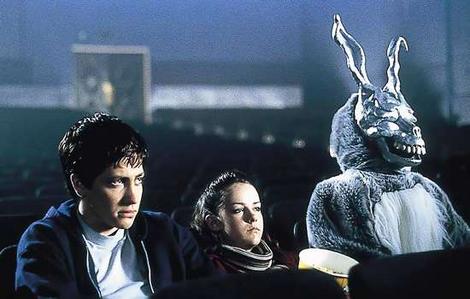
  • Donnie Darko (2001): This movie may be a one-hit wonder for Richard Kelly, who has not really done anything as mystifying as his debut -- but, oh, what an experience. I honestly think my feelings for this movie are more for how I saw it than the movie itself: after the slow boil at midnight screenings, I caught this with a graduate student at a midnight screening at the now-defunct Visions Theater while my wife was out of town. Baffled yet mesmerized by the movie, we realized that this one merited some discussion -- but I had to run to catch the last bus back to Glover Park. The grad students begged me to go for coffee -- and I suddenly realized that yes, indeed, I could stay out late! The conversations that the movie engendered were generally thrilling, with all sorts of viewers postulating about what the giant rabbit torturing Jake Gyllenhaal might mean; that alone makes it one of the most thrilling movie experiences of the decade. I saw the subsequent "Director's Cut" once, and never again: his clarifying his own film made me like it far less, and I much prefer the ambiguous original release.
  • Eternal Sunshine of the Spotless Mind (2004): I notice that my list is terribly romantic, which amuses me given my own penchant for dark material. Sunshine, however, was irresistible from the get-go, combining the melancholy/beautiful nature of love with the wacky/ordinary nature of a small company erasing memories for those who want it. (That the pic is set in Rockville Centre, next to my hometown of Baldwin, is a bonus.) Kate Winslet and Jim Carrey are delights playing against type -- and against each other -- and the doomed couple, and the movie looks dirty/lovely throughout, with Gondry realizing that the most powerful way to use technology is to make it look ordinary.
  • Hable con ella (2002): This would probably be my pick if I had to only list one favorite: Almodóvar's engrossing love story that focuses, oddly enough for him, on men. I am a huge fan of the Spaniard (heck, I taught a course on him), and this movie cemented the deal for me (even though I really love Todo sobre mi madre and La mala educación -- which I didn't get at first, and now also totally enthralls me). I love the ethical strings this movie pulls at (what do you make of an otherwise nice guy who suddenly does something morally reprehensible -- and what then, when that act results in something positive?), and the movie is fun to teach to freshmen, who otherwise like their movies black-and-white, at least when it comes to good-and-bad. The performances throughout the film are matched by the multiple performances within the film: Caetano Veloso singing a hreatbreaking version of "Cucurrucú, paloma"; and the two dances that bookend the film so beautifully.
  • In the Mood for Love (2000): Peoplse who know my taste in movies know that I am all about sumptuous atmosphere with many layers to them. (This list only proves that point, I think.) Of the list, however, Wong Kar-Wai's sumptuous love letter to Tony Leung, Maggie Cheung and the six thousand dresses that she wears throughout the film also has a complex love story to boot. The scene where they confront (and confirm for) each other that their spouses are having an affair, set to Nat King Cole singing in Spanish, is one of my favorite scenes in film.
  • Madeinusa (2006): So over the last decade, I happened to write a book about Peruvian cinema and all -- and yet this film only got one line in the whole tome. I agreed to lead a discussion about this film, sight unseen, sponsored by my university library -- but when it was over, I was in such shock from what I had seen, I barely knew how to begin. This assured first feature from Claudia Llosa is my current obsession (and the subject of an article in the works, heh heh), where Magaly Solier's performance dares you to not appreciate the levels at work throughout the film.
  • Moulin Rouge! (2001): We drove all the way to Santa Cruz back in the day to see this film, and were not that impressed when we saw it. After three separate times of teaching a course on the musical, I now completely love this film. Part of it is really wishing that I were Ewen McGregor; part of it, I'm sure, is that he sings "Your Song," which I serenaded Angela with before we were married; part of it must also be that Angela and I duet on the soundtrack when we go on long drives. But the flash and dazzle of the movie (somehow) holds, and more effectively that one would think. (It even does Singin' in the Rain one better by actually making the only new song a plot point.)
  • La niña santa (2004): I don't know whether this is the most melancholy melodrama or terrifying horror film I have seen in ages, but Argentine Lucretia Martel worked magic over the course of this decade. This whole movie, revealing the tensely wound stories festering in a hotel in the same location as her debut film, La ciénaga, seems to be shot in close-up, providing us with an uncomfortably intimate view of people gone horribly wrong.
  • Punch-Drunk Love (2002): I still really love this movie, more so than the other PTA flicks, largely because it becomes a minimalist tone-poem of sorts for Adam Sandler (whose shtick finally gets exposed as horrific rather than funny) and Emily Watson (who is, like, ah-maaazing). This was one of the first films I ever assigned for my introductory film class for their final papers, which yielded the most dynamic set of papers I have ever read. Th
  • Reconstruction (2003): Even though Breaking the Waves is one of my favorite films ever, I tired of Dogme films from Denmark by the middle of the decade (this, despite my love for Dancer in the Dark). Hence, I found this truffle from Christoffer Boe (seen at Telluride) a true visual delight, with an intriguingly meta-narrative that was beautiful and painful at once.
  • The Triplets of Belleville (2003): Another Telluride find. As I was contemplating the really fantastic Pixar flicks throughout the decade -- especially the work of Brad Bird, Ratatouille and The Incredibles -- I found myself coming back to this largely wordless gem, another love poem for yesteryear's animation, even as it uses some cutting edge processes to achieve them. (The bicyclist's wheels, for example, are digitally rendered.) The film has a joyful soul that is tinged with melancholy, and made it truer than most of the non-animated films that we see.
  • Yi Yi (2000): Yet another Telluride find, and a surprise hit there in the same year that another Taiwanese film took most of the thunder. I could not imagine a three-hour-long film about contemporary Taiwan, performed by many non-actors, would be even remotely interesting. How very wrong I was: I was riveted throughout the screening, and have every time I have seen it since. This was also the reason I was profoundly sound when the director, Edward Yang, died toward the end of the decade.
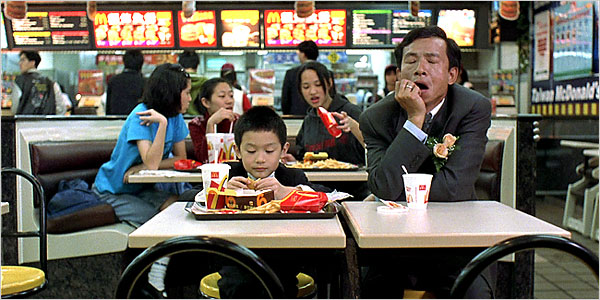
  • Y tu mamá también (2001): You knew this was coming. After all, Alfonso Cuarón happens to be the topic of my new project. And, let's face it, those eyes at the top of this blog come from this film. I have now seen this startling movie at least a dozen times, sometimes for class, sometimes for myself, and I am still finding new elements to the film. I first saw this in DC at a preview screening with a lot of gray heads in the audience, most of whom were confused by the sex-laden road-trip without confronting the really nuanced commentary lying just beneath the surface. Cuarón was there -- and now, oh, how I wish I had said something. That his other two films (Children of Men and yes, Harry Potter and the Prisoner of Azkaban) also could have made this list may say something about my auteurist obsession -- but may also say something about the quality of his work as well.

Wednesday, December 23, 2009

Videodrome

The current state of the weirdness of our movie-viewing culture (where we watch things on cable, on demand, online, on Netflix, on, Donder! on, Blitzen!) has resulted in the downsizing of Blockbuster. This should surprise absolutely no one, given their gigantic expansion nearly everywhere and the subsequent squeezing out of nearly every locally owned video store. (My own local store, Video Americain, is a mini-chain of four stores, and wonderfully eccentric. When you want to get, say Desk Set, you wonder whether it is listed under "Classics," "Katherine Hepburn," "Comedies" or "Walter Lang." Inevitably, you have to ask one of the semi-snotty employees. I love this place.) I have no love for Blockbuster whatsoever, given that they inevitably never had anything I wanted. At the one located 10 minutes away from my in-laws' place on Cape Cod, an employee finally admitted to me that although they receive virtually everything, anything that had not been rented in three months went on the "Previously Viewed For Sale" rack.

Actually, this is the only reason I ever liked Blockbuster: because the stuff I wanted would rue of quickly go on sale in the discount rack. This was particularly true of anything subtitled. ("Sir, you do realize that this movie is subtitled." "Yes, that's why I want it. The other ten in the basket are also subtitled.")

So, I have to say that the wonderful thing about the mass Blockbuster closing has been the sale. And because I don't need a copy of The Hangover, I can get all sorts of cool stuff that everyone has passed over. This is particularly cool now that all DVDs have gone down to $3 per disc. And hey, for me, this is a tax deduction! (Seriously, I'll probably use several of these in class; I already showed Hedwig and the Angry Inch as the final exam in my course on the musical.)

I had already passed through the store in Langley Park, MD a few weeks ago and hope to swing by the College Park one before they close when I get back to the DC area; yesterday, I cleaned out the one here in North Falmouth.

I can't be the only film geek doing this, however. When Hollywood Video closed last fall near campus, I picked up all sorts of cool stuff, including the Criterion version of Overlord; in Langley Park, I nabbed a whole bunch of Spanish-language stuff like Cilantro y Perejil and Tésis. I'm curious to know what other folks have picked up -- so, in an effort of full disclosure, here is what I nabbed from North Falmouth (and if you want to know why, just ask -- and I will tell why):
(Note: I'd actually like to pick up a copy of some Tyler Perry movie, but they were out of Diary of a Mad Black Woman. Can anyone suggest a better Tyler Perry?)

Monday, June 08, 2009

Hot off the press!

Back in 1998, I was floundering about for a dissertation topic when I took a graduate level French course on Cahiers du Cinéma with Carina Yervasi and was introduced to the concept of film journals. By this point, I had already learned a great deal about Latin American film history and, as a final project for this class, I decided to examine each and every page of Cahiers to look for material on Latin American film. This proved to be an arduous project -- but, oddly enough, also an exhilerating one, of sorts. (That paper is still in my electronic "trunk" of sorts, trying to burst its chains to try publication again. Quieto, quieto, soon, my friend...) I started looking for Latin American film journals written around the period of the 1960s and 70s, a high point of filmmaking from the region and discovered that the only one to survive the period of New Latin American Cinema from beginning to supposed end happened to come from Lima.

Lima? Peru?? Home?? But were there any movies made around then? Then why would one of the most respected film journals in Latin America come from a place that really didn't make any movies? It didn't make any sense.

Eleven years later, you can finally really read what I learned. Behold: my book. Finally. I hold the first copy, before the go on sale for real at the end of the month (although Amazon has it available at a discount for pre-order now! I know, I hate Amazon -- but, hey, discount!). In this picture, you can also see the snazzy cover art. I have to say: UPNE definitely knows how to make a pretty book. They rock.

Eleven years. Given that I've already started the next project, here's hoping it's not another decade until the next one. Huzzah!

Wednesday, March 18, 2009

If we have to wear green on the 17th...

...then let it be cinematically green!

Great Expectations

A Little Princess


(And check out the eyes in the banner, from Y tu mamá también, which I actually screened tonight to my class!)

Celebrating the two filmmakers I most associate with the color green: director Alfonso Cuarón and cinematographer Emmanuel Lubezki. Not even remotely Irish, just like me!

Saturday, February 14, 2009

Cine peruano es lo mejor

And when I say that Peruvian film is the best, this time (and for the first time) I actually have some proof to back me up.


A few weeks ago, Peruvian film blogs were all aflutter because Claudia Llosa's new film, La teta asustada, became the first Peruvian film to play in competition at the Berlin Film Festival, one of the top film festivals in the world (the level of Cannes, Venice, etc.). The movie considers the idea that the fear experienced during the period of high terrorism in Peru (the Shining Path years through the 1980s, which actually correspond with my own time in Lima) can be trasmitted through breast milk across generations, particularly among those who were raped. Certainly, Peruvian filmmaking has tackled the subject of Sendero Luminoso before, but perhaps not quite from a perspective this personal or traumatic, certianly not from the perspective of a woman. Selection for the festival was huge news and one which the Peruvian cineblogosphere got very excited about. Sure, Peruvian films had gone to San Sebatian, or Sundance, but none had ever gotten this far. It was quite an honor to be nominated, and the Peruvians were having a great time with it.

I'm pretty sure no one expected the movie to win.

And yet, lo and behold, there you can see Claudia Llosa, the director of La teta asustada kissing her Golden Bear. Reuters reports that Llosa commented simply, "This is for Peru. This is for our contry." The first time a Peruvian film actually gets to play in the game, it wins.

Wow.

Granted, I have a huge vested interest in this film and Peruvian film in general since, after all, I have a book on the topic coming out in just a few months. (You can even pre-order it! Shameless plug!) I have not even seen the film, but the trailer is very impressive. I also confess to being a smitten fan of Llosa's only other film, Madeinusa, which I knew I had to write about even before I finished watching it. That movie completely rocked my foundation about film in general, not to mention films coming from my "other country." It is beautiful, disturbing, unique in its storytelling. I am not surprised that Llosa's follow-up appears to have similar qualities.

Very few people are pointing out the fact that Llosa is only the third woman to ever direct a feature-length movie in Peru (along with Nora de Izcué and Marianne Eyde). Filmmaking (and film criticism) in Peru has been dominated by men since the very beginning and the number of impressive films centered around women are very few; even fewer are those focusing on Quechua-speaking women. The win is a huge thunderbolt to Peruvian film and may shake many foundations there.

Not to mention that drop-dead gorgeous lead actress Magaly Solier now has the honor of being kissed on the hand by none other than drop-dead gorgeous (and amazonian in her own way) jury president Tilda Swinton.
I can't wait to see the film for myself. ¡Viva Perú!

UPDATE: Variety has its review up as well as coverage of the event. And there is a YouTube clip of the announcement, including a mesmerizing speech by Magaly in Quechua. (No, I cannot translate it.)

Tuesday, February 10, 2009

If you're looking for something to watch on DVD this week...

...AU's Media Services currently has my suggested flicks on their blog. Feel free to peruse at your leisure -- and let me know what you think if you've seen any of them.

Sunday, January 04, 2009

Best Supporting Actress, Class of 2008: Diane Wiest


Gosh, I wasn't going to do this this year. I have been embarrassingly lax in going to the movies this year. I said this last year but I did an even worse job this year. Stinkylulu has been reminding me for weeks about this, and I've been pained about it because I thought, "You know what? I have nothing."

And yet...

It's the list that's currently up that inspired me. Granted, it's a very strong list, which is typical of this particular effort, since people really defend their choices well. In particular, I noted the various nods toward Synecdoche, New York, which had a slew of wonderful acting going on, mostly by women and mostly in supporting roles. (The casting of this film is so uncanny that I had to get to the end of the flick to realize that Samantha Morton was not doing double duty, that my crush-object Emily Watson looks so much like Morton made digital editing unnecessary. Michelle Williams also proves once again that her previous nomination was no fluke.)

But I realized that my own favorite from that film was missing from the list.

I'm discovering over the course of these blogathons that I'm drawn to the performance that for me yields the crux of the entire story. For me this year, and particularly for this film, that performance was masterfully maneuvered by the queen of contemporary supporting actressing, Diane Wiest. Really, has she done lead work that equals the strength of her supporting performances? It seems redundant to mention it here, and her again -- and yet, it is so deserved here. The character of Ellen becomes the one that Caden melts into (or is it the other way around); Wiest proves to be the one person able to be dismissive at first blush as she enters the world of Synecdoche, only to take it over completely (and literally) by the end. We believe her in this position. Part of it, I realize, is from the power that her supporting-actressing yields here -- but it's power well-used by Kauffman, to the extent that she only needs to appear in the last quarter of a rather long film to make it work.

For these reasons and more, I submit my candidate for Best Supporting Actress 2008: Diant Wiest.

This entry is part of the 3rd Annual Supporting Actress Blogathon -- please feel free to visit the other sites on the list, since I know for sure they have probably seen more films than I have and the list is always fun and varied

Friday, December 26, 2008

The snow always shines on TV

Earlier this month as the holiday season came upon us, I was chatting with my dean about favorite holiday flicks; my head currently embroiled in Ernst Lubitsch films, I mentioned The Shop Around the Corner as a favorite. "For me," she said, "I love nothing better than the hokey wonderland that is White Christmas. I just love that film."

"If you can believe this," I said, "I've never seen it."

Her jaw dropped. Indeed, somehow I have never managed to catch Bing, Danny, Rosemary and Vera-Ellen do their post-WW2 tinsel-wrapped spectacle in any form (television, video or otherwise). I have no idea why I missed this, since I'm a sucker for everything that the movie stands for: musicals, Bing Crosby crooning, implausibly mild Vermont winters, etc. My dean (who is not a film expert, mind you) was genuinely upset that I had not seen this; within two days, a DVD copy that had been lying around her house appeared in my departmental mailbox. The end-of-semester grading mayhem quickly commenced, however, and I didn't get to watching it, despite her constant cajoling in the hallways, until a few days before Christmas, with my parents in town and a cold wind blowing outside.

Since I'm still ovewhelmed by holiday cooking, I'll say that my first response is that White Christmas is something like a meringue: a light, fluffy, pretty confection that isn't very filling. I was stunned to find that a drag routine done by two of the most popular jocks in my Peruvian high school was lifted verbatim from this movie (costumes and all!); I was less stunned to discover that Donald O'Connor was originally slated to do Danny Kaye's part, given its similarity to his role in Singin' in the Rain.

I decided to post about the movie after reading a holiday posting by Glenn Kenny on the film, mainly because one particular aspect piqued my professional curiosity and has stuck with me. The plot finds Bing Crosby and Danny Kaye up in Vermont at Christmastime, where their beloved general has fallen on hard time following the War while running an inn; to cheer him up, the boys decide to ask all the members of their infantry who live in New England to come to Vermont for a surprise. In order get them there quickly, however, Bing decides to go to New York and appear on the Ed Harrison television show (Harrison also being a fellow infantryman, coincidentally enough) to encourage them to come. Everyone watches this show, including the general (Kaye must fake a knee injury to get the general out of the room from where the television set is located) and Rosemary Clooney, who watches backstage from the nightclub act that she is doing in New York when she mistakenly thinks Bing is using the general's plight for cash.


This use of television fascinates me and I want to investigate it more. For one thing, using television as part of the plot seems to run counter to the entire point of the movie in the first place, since the film was known and marketed at the time for being the first to be filmed in Vistavision, Paramount's entry into the widescreen market. From what I understand (and it's been a while since I've read Bolton's book on widescreen), this technological innovation was meant to combat the encroachment of television into the entertainment market. (Drive-in theaters and 3D also were technological innovations, but widescreen is the most interesting to me). It is therefore somewhat surprising for me to see a television screen within a wide theatrical screen. From an international perspective, this might have been the first time that some countries would have seen televisions and how they might be used; according to this, television didn't arrive in Peru until 1958, and this movie was released four years earlier and was undoubtedly screened there. So what was the general reaction to seeing television in this film? And what about in the United States? Why did Paramount choose to include the use of television as part of the plot, when the movie industry was trying to combat television? How many other movies in the 1950s did this? What kind of relationship between TV and movies existed for this?

We'll see. Give me your thoughts, if you want, and let's see what happens.

Saturday, November 22, 2008

Back from outer space (or maybe just Macchu Picchu)

I'm so very sorry that it's taken me this long to get posting again. In all honesty, I simply vowed that it wasn't right for me to blog while I still had some papers due back to my students. It's been a rougher semester than what I originally planned. Among other things, the infamous tenure file got submitted and I had to quickly race through edits on the book. Speaking of which, as it turns out, if you think I'm not legit about this whole getting published thing, I apparently now have an official ISBN! How exciting! You can now even read the synopsis, and even pre-order at Amazon! (Hopefully by the time a cover is designed and/or the book actually gets published, the powers that be will have figured out that my middle initial isn't "R." Sigh...) I can't think of anything more fabulous than that.

Well, maybe I can. Because you know what would be really fabulous? These days, I've been getting into Bollywood movies a little more. I even showed Dil se... to my general class this semester. What a shame, however, that I can't combine my growing interest for Bollywood films and my Peruvian heritage. I mean, wouldn't it be cool if, say, a Bollywood film were to film in Peru or somethng? Maybe some giant science fiction flick starring worldwide goddess Aishwarya Rai frolicking around Macchu Picchu with some alpacas frolicking in the background?


Well, well. Dreams really do come true!

And this flick might even be better than the last science fiction film set in Peru (which, mind you, encouraged the main Lima newspaper El Comercio to create a brand-new "no-stars" rating). The only reason to apparently see that flick was to catch super-telenovela hunk Cristian Meier naked. That, and a fake UFO over Maccu Picchu.

Thursday, October 30, 2008

Would Disney-owned ABC show movies about leggy, murderous transvestites?

When The WB and UPN merged to become the WB, the leftover stations apparently turned into a network lamely called myNetworkTV. According to Wikipedia (and I remember this when they started up), they originally began as the place where English-language telenovelas started up; they didn't catch and, quite frankly, I am never sure what these stations are for except as literal way-stations from one of out PBS affiliates to the other.

Except that occasionally these networks show some pretty funky movies for network television.

I haven't been watching too much prime-time network TV, but it's fun to do while folding laundry. About a month ago, I remember channel surfing and discovering to my amusement that Lars von Trier's Dancer in the Dark was showing. Thinking that only PBS would have the nerve to show a long, difficult film with non-stop handheld camera punctuated by musical numbers all featuring Bjork, I was truly shocked when all of a sudden a commercial for fast cash appeared.

Tonight, they appear to be showing The Rocky Horror Picture Show.


Who is programming this stuff? This is great.

Sunday, September 28, 2008

Raising my bottle of vinaigrette

Oddly enough, one of my favorite Newman clips remains this screen test for East of Eden:


Naturally, I think this in part because James Dean is in it and everyone knows how I swoon for Jimmy. (Note: Giant played on PBS tonight. All kinds of good.) But man, this is so wonderful in part because Dean and Newman are so wonderfully different. Dean is clearly taunting the boy with the bowtie in a very sexual way -- and I don't say that just because he says, "Kiss me." The mutual stare at the end almost looks like they will either come to blows or make out. Either way might have worked for the film.

The funny thing, of course, is that it's arguable that Newman got his big break because of Dean's untimely, pointless death. His role as Rocky Robert Wise's Somebody Up There Likes Me broke Newman out of pretty-boy roles on television and into film and, quite frankly, the movies were never quite the same (or at least the leading men). As much as I am a Dean fanatic, I'm fairly certain that, like his idol Brando, he would have burned out or became large and eccentric had he survived. At the very least, he would never have had the career that Newman did -- or, indeed, the life that Newman did. The clip above is a funny reminder of how two stars diverged so very much from this point on -- and yet how both have gone down in infamy glow brightly, only in our collective memory.

Thank you, Paul.

Wednesday, September 24, 2008

He knows not of what he narrates

No, I am not referring to any of my lectures. I am referring to my son's current narrative strategies, which is to take several things he has learned about and combine them into a new, even more exciting story. As I have previously mentioned, The Blob has already entered the family parlance, although now it refers simply to tasty jello. Somehow, however, the boy did manage to also process the correct definition of "The Blob," i.e. scary monster that creeps (and leaps and gliiides... OK, yes, please stop me now). I swear, he hasn't seen the movie. (Yet.)

This was apparently combined this evening at dinnertime while Angela and Xan were riding home together on the bicycle with the concept of "robots," apparently acquired through a friend at school. (I was not a first-hand witness to this, by the way, because it was "back to school night" at the preschool and I was the one on hand; at this meeting, the parents of the aforementioned child wanted to know is "camping" was a topic at school, because their son suddenly wants to go camping. It's hilarious how quickly these concepts are picked up.) Add the ever-constant Thomas the Tank Engine, who appears in all narratives these days. (Even when they involve pirates. Don't ask).

This results in the following narrative, explained matter-of-factly by Xan to Angela tonight: "The Blob and the robot were chasing after Thomas very, very fast. Thomas was scared -- but then he was faster and got away. From the Blob. And the robot. Who was big."

Personally, I think this would make a fantastic movie myself.
Apparently, Thomas doesn't share my opinion.

Friday, September 19, 2008

After all, it's just jello...

As indicated by the last post, we're becoming slightly obsessed with The Blob over here chez Middents-Dadak. Since Angela has been posting about this on her Facebook page, I suppose I let the world know why. For the last few years, our department has hosted a Literary Dessert Party, featuring all sorts of inventive confections inspired by works of literature. Since I am one of the film folks, we decided last year to enter with a film-inspired dessert instead. (You can see last year's entry here.) I still like the idea of One Hundred Cookies of Solitude, but our oven's being on the fritz prevents that from happening. In fact, that prevents most desserts... except, of course, gelatin.

Hence: our entry this year will be The Blob.

Angela gets all the credit for this, having heard the NPR story about the flick's 50th anniversary last week. I did go out, however, and acquire the flick from the library's collection. It was wonderfully campy and, I thought, hilariously funny, right from the opening credits with the fab Burt Bacharach theme song. ("Beware of the blob, it creeps, and leaps and glides and sliiides across the floor!" Priceless!) I watched it on Tuesday when no one else was home and was telling Angela all about it at the dinner table that evening.

Xan, of course, was listening. "Can I see The Blob, Dad?"

Angela looked at me and said, "I don't know. Can he?"

I considered this. Remember that he has been exposed to a grand total of about a half-dozen movies in his lifetime so far, mainly ones featuring musical numbers or trains like Singin' in the Rain or The General. So if we were to show him The Blob, it would be one of the very few we've allowed. On the one hand, I'm loathe to show him what is actually a horror movie at the tender age of three-and-a-half. On the other hand, when I taught my course on horror movies, my students indicated that they had been exposed rather early to really terrifying movies at the age of five. Besides, the boy has already entered Pirates phase and is all about swashbuckling and what-not. (There seems to be a progression of interest from trains to dinosaurs to pirates among young boys; if this is true, we seem to have skipped over the Tyrannosaurus for now.) So how much harm would cinematic man-eating jello cause? Certainly this is less creepy than Grimm's Fairy Tales (which we also haven't started) and I suppose there are worse things to happen than to develop jangelaphobia.

Luckily, I had to return the movie before Xan could watch it. But now he's curious about it. So I open the idea to you: do you think it's to early for The Blob? (It creeps!)

(By the way, we are not dressing him as the Blob for Halloween. Although maybe that's not a bad idea for me...)

UPDATE: In case anyone wants to see what the end result looked like (although it's a shame you can't taste it, because it tasted far better than it looks...):

Tuesday, September 16, 2008

Beware the Blob!!

I just got finished watching The Blob and all I have to say is that if the Republicans want a real reason to prevent climate change, perhaps they should consider what's frozen up there...

Saturday, August 23, 2008

CAMERA


CAMERA
D: David Cronenberg, Canada, 2000, approx. 7 minutes.
Source: Viderdrome (Criterion Collection version)

A narrator starts to tell a story off-camera: "One day, the children brought home a camera." It's a simple statement; it starts simply, with a man -- no, not a man: an actor. Images of the children with the camera are intercut with images of a nice gentleman with graying hair, shot with a video camera in medium shot. As he continues, however, the (video) camera starts to push forward, so that the man is in close-up when he announces something unexpected: "When you look at it in a cold light, photography is death."

Camera continues a fascinating interplay of images as the actor delivers a monologue about the "dangers" that the Camera proposes. The children matter-of-factly do all the tasks needed to make a movie: check lights, process film, measure the f-stop; these are all shot in a very matter-of-fact manner as well, with relatively "normal" lighting and camera distances. These are all in stark contrast to the images of the actor, who the video camera moves into shots so close that we as viewers feel uncomfortable. The actor appears unattractive, even sinister: the light from the windows appears too harsh, his eyebrows are thick and menacing. The actor is also edited in an odd manner: often, we are presented with jump cuts to sudden extreme close-ups of his eyes. The images are not necessarily horrific, yet the tone established throughout this piece is horrific.

In many ways, Camera is an interesting precursor to Cronenberg's 2005 feature film A History of Violence, which cannily comments on the movies in a similar way. In that film, scenes of violence and gore which would otherwise titillate the viewer are presented in a stark, cold manner than unnerves even the most seasoned viewers, making us question the very nature of the horror film genre. (One can argue he this is a common preoccupation for the director, also seen in eXistenZ, Naked Lunch and especially the brilliant Videodrome, which also featured Leslie Carlson, the actor featured here.) In Camera, Cronenberg does not present any gore and yet the whole film is structured to terrify. I particularly like this piece because the link between photography and death so clearly derives from Roland Barthes' tragically final work Camera Lucida. These ideas were not academic for Barthes: the work is inspired by his mother's death, and every photograph of her does not remind him of the joy that her life brought, but instead serves to mock him, reminding him that she is dead. Cronenberg highlights something very similar: the life captured by motion pictures only demonstrates that such moments cannot be repeated and taunt us with what once was and can never be again.

Camera becomes truly haunting in the last minute or so, when the children bring the large, old 35mm camera into the room with the actor. They apply make-up, change everything around and then a young boy (bespectacled, like Cronenberg) says, "Action." And suddenly, the image changes: it is warm, gorgeous, widescreen. And suddenly we realize that the harshness of everything that has come before is largely due to the use of video instead of film. (This section was actually filmed with the very camera seen throughout the short.) And yet, as soft and beautiful as this looks/sounds/feels, we are acutely aware of everything that the actor has noted before this. He repeats his initial line -- "One day, the children brought home a camera" -- but the line is changed, no longer innocent. And this time, the shot hangs on just a little too long. It catches the actor's face in a private moment: in the last seconds of the film, Carlson's face breaks for just a moment, his eyes watering and distant, filled with despair. The film cuts away to black -- and the effect is terrifying. Can we watch movies again the same way?

This entry is part of the Movies About Movies Blogathon hosted at GoatDogBlog -- please feel free to visit the other entries listed on that site. This is also cross-posted as the first entry at the newest incarnation of The Short Films Blog, the blog associated with my course this semester. New entries on short films will appear every day until December 11th, with students starting to post next weekend. Please visit there often -- and comment on the students' work, since they earn extra credit for more comments!

Saturday, August 16, 2008

I don't watch movies. I prefer good film criticism.

I just found out that Metropolitan, one of my favorite movies from the early 1990s, just got release on Hulu, of all places. The movie was an oddly daring debut from director Whit Stillman, and garnered a well-deserved Best Original Screenplay Oscar nomination for a talky piece about some rich kids maneuvering through the upper echelon of Manhattan.

I saw this when I was a freshman or sophomore in college, just before I started really appreciating "films" and yet I found this movie utterly refreshing, having giggled incessantly throughout. I thought that perhaps it was because I was at Dartmouth, where many of these people who were really so full of themselves seemingly ended up (or so it seemed, work-study kid that I was, surrounded by what seemed to be very privileged people). On my exchange term at UC-San Diego, however, I convinced someone on my hall -- a very loopy, arty guy that I respected -- to come to a campus screening with me, and he laughed throughout the whole movie and thanked me profusely when it was over.

There's a great moment which, I'm sad to say, isn't spoken by my favorite character, the insouciant Nick (played with gleeful abandon by Chris Eigeman), but rather in an exchange between Audrey (Carolyn Farina) and Tom (Edward Clements). (I wasn't able to snip out a clip from Hulu, so look for it around the 27-minute mark.) Not so surprisingly, Audrey loves Jane Austen and is unnerved by Tom's vehemence against her work -- when all of a sudden he admits the he's never read Austen at all. "Oh no," he says, "I don't read novels. I prefer good literary criticism. That way you get both the novelists' ideas as well as the critics' thinking."

Every so often, I wonder about whether literature (and film) professors in general suffer from this conundrum. And then they wonder when people like Audrey, who rightly live in the pleasure that the book provides, think that we're nuts for looking too closely at what we read.

Thursday, June 19, 2008

With the family out of town...

...I've naturally taken to watch some porno.


Particularly, you know, if said porno features Isabella Rosselini. And an impish grin. Meow.

(Hat tip to Stinkylulu! This turns out to be great stuff for my fall course...)

Wednesday, June 18, 2008

Nothing beats a great pair of legs

My students hate the "Broadway Melody" sequence. Every time I show Singin' in the Rain (which is practically every semester, since it is a great film to reference throughout any film course), I always brace myself when we get to the big number about three-quarters' through the film. It stops the plot dead with absolutely no relevance to what has come before and it will take about 17 minutes for us to return to the story at hand. No matter that this was the reason why audiences went to see the film back in 1952, my students generally hate the sequence.

But oh, those legs. No one can deny those legs.

Every time I see Singin' in the Rain -- which, between my classes and my son, is often -- I still get chills every time those green-clad legs come on screen. I remember that even as a kid, I was mesmerized by those legs. Cyd Charisse never says a single word and yet, in this spectacle-within-the-film, she has a brilliantly executed character arc, created only by dance. And while the movie isn't done in widescreen, Charisse's stretched legs certainly makes it seem otherwise.

Charisse's passing follows the other greats from the film: Lina Lamont (1977), Don Lockwood (1996), Cosmo Brown (2003); only spunky Kathy Seldin remains with us. Each one dancing into the afterlife makes me thankful for the wonderful world they left behind. Mme. Charisse, you will be missed.