Showing posts with label ranking. Show all posts

Tuesday, December 29, 2009

Aughts, to be in pictures

Ten years ago on New Year's Eve, I remember working at this family restaurant in Pacific Grove, California, where my wife-of-less-than-a-year came specifically to bring me to the rocks by the beach so that we could watch the world end.

Remember, of course, that the end of the last decade was also the end of the millenium, and that this would cause all our computers to go back to 1900, and then we would all be plunged into the dark ages, and chaos and, well, yes. Prince had, after all, warned us that the end was then. So, in the immortal words of the Kitchens of Distinction, what happens now?

Lots of film folks are weighing in with their best-o'-the-aughts, none better in my opinion than Nick, who has a wildly and wonderfully eclectic list with morsels of information indicating why he likes them. Given that we had some free time coming home this last weekend whilst driving on the Delaware Turnpike Parking Lot, I mused upon what my own list would look like. Unlike any other film person writing right now, however, I cannot claim that I have seen a gargantuan number of movies this decade, what with the arrival of a job, a child, a book and tenure (in that order) over the last few years. (This is why I like Nick's list, since it provides a checklist of the most tantalizingly raised foie gras as well as the funkiest salted popcorn.) My own preference for certain kinds of movies therefore warps this list considerably; that there are fewer that come at the end of the decade is also no surprise, given that I have seen fewer films as the decade went on. Yet these, a baker's dozen, happen to be the movies that stick in my head, which is the greatest praise I can think of:
  • Brokeback Mountain (2005): When we first saw this movie at Telluride, Angela and I were a little underwhelmed; rumored even then to be the break-out hit of the year, we thought it a bit slow and Heath Ledger a bit... well, mumbly. We admitted at the time that it could have been simply because it was the fifth movie of the day, and that we were damn tired. Years have passed, the hype is over, the Oscar lost, the actor buried -- and still, the movie has a haunting lilt for me. I have since taught the film as a wonderful exercise in adaptation, given that Ang Lee imbues the spaces in Proulx's story with a delicate hand.
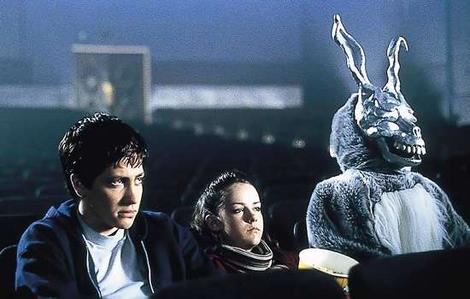
  • Donnie Darko (2001): This movie may be a one-hit wonder for Richard Kelly, who has not really done anything as mystifying as his debut -- but, oh, what an experience. I honestly think my feelings for this movie are more for how I saw it than the movie itself: after the slow boil at midnight screenings, I caught this with a graduate student at a midnight screening at the now-defunct Visions Theater while my wife was out of town. Baffled yet mesmerized by the movie, we realized that this one merited some discussion -- but I had to run to catch the last bus back to Glover Park. The grad students begged me to go for coffee -- and I suddenly realized that yes, indeed, I could stay out late! The conversations that the movie engendered were generally thrilling, with all sorts of viewers postulating about what the giant rabbit torturing Jake Gyllenhaal might mean; that alone makes it one of the most thrilling movie experiences of the decade. I saw the subsequent "Director's Cut" once, and never again: his clarifying his own film made me like it far less, and I much prefer the ambiguous original release.
  • Eternal Sunshine of the Spotless Mind (2004): I notice that my list is terribly romantic, which amuses me given my own penchant for dark material. Sunshine, however, was irresistible from the get-go, combining the melancholy/beautiful nature of love with the wacky/ordinary nature of a small company erasing memories for those who want it. (That the pic is set in Rockville Centre, next to my hometown of Baldwin, is a bonus.) Kate Winslet and Jim Carrey are delights playing against type -- and against each other -- and the doomed couple, and the movie looks dirty/lovely throughout, with Gondry realizing that the most powerful way to use technology is to make it look ordinary.
  • Hable con ella (2002): This would probably be my pick if I had to only list one favorite: Almodóvar's engrossing love story that focuses, oddly enough for him, on men. I am a huge fan of the Spaniard (heck, I taught a course on him), and this movie cemented the deal for me (even though I really love Todo sobre mi madre and La mala educación -- which I didn't get at first, and now also totally enthralls me). I love the ethical strings this movie pulls at (what do you make of an otherwise nice guy who suddenly does something morally reprehensible -- and what then, when that act results in something positive?), and the movie is fun to teach to freshmen, who otherwise like their movies black-and-white, at least when it comes to good-and-bad. The performances throughout the film are matched by the multiple performances within the film: Caetano Veloso singing a hreatbreaking version of "Cucurrucú, paloma"; and the two dances that bookend the film so beautifully.
  • In the Mood for Love (2000): Peoplse who know my taste in movies know that I am all about sumptuous atmosphere with many layers to them. (This list only proves that point, I think.) Of the list, however, Wong Kar-Wai's sumptuous love letter to Tony Leung, Maggie Cheung and the six thousand dresses that she wears throughout the film also has a complex love story to boot. The scene where they confront (and confirm for) each other that their spouses are having an affair, set to Nat King Cole singing in Spanish, is one of my favorite scenes in film.
  • Madeinusa (2006): So over the last decade, I happened to write a book about Peruvian cinema and all -- and yet this film only got one line in the whole tome. I agreed to lead a discussion about this film, sight unseen, sponsored by my university library -- but when it was over, I was in such shock from what I had seen, I barely knew how to begin. This assured first feature from Claudia Llosa is my current obsession (and the subject of an article in the works, heh heh), where Magaly Solier's performance dares you to not appreciate the levels at work throughout the film.
  • Moulin Rouge! (2001): We drove all the way to Santa Cruz back in the day to see this film, and were not that impressed when we saw it. After three separate times of teaching a course on the musical, I now completely love this film. Part of it is really wishing that I were Ewen McGregor; part of it, I'm sure, is that he sings "Your Song," which I serenaded Angela with before we were married; part of it must also be that Angela and I duet on the soundtrack when we go on long drives. But the flash and dazzle of the movie (somehow) holds, and more effectively that one would think. (It even does Singin' in the Rain one better by actually making the only new song a plot point.)
  • La niña santa (2004): I don't know whether this is the most melancholy melodrama or terrifying horror film I have seen in ages, but Argentine Lucretia Martel worked magic over the course of this decade. This whole movie, revealing the tensely wound stories festering in a hotel in the same location as her debut film, La ciénaga, seems to be shot in close-up, providing us with an uncomfortably intimate view of people gone horribly wrong.
  • Punch-Drunk Love (2002): I still really love this movie, more so than the other PTA flicks, largely because it becomes a minimalist tone-poem of sorts for Adam Sandler (whose shtick finally gets exposed as horrific rather than funny) and Emily Watson (who is, like, ah-maaazing). This was one of the first films I ever assigned for my introductory film class for their final papers, which yielded the most dynamic set of papers I have ever read. Th
  • Reconstruction (2003): Even though Breaking the Waves is one of my favorite films ever, I tired of Dogme films from Denmark by the middle of the decade (this, despite my love for Dancer in the Dark). Hence, I found this truffle from Christoffer Boe (seen at Telluride) a true visual delight, with an intriguingly meta-narrative that was beautiful and painful at once.
  • The Triplets of Belleville (2003): Another Telluride find. As I was contemplating the really fantastic Pixar flicks throughout the decade -- especially the work of Brad Bird, Ratatouille and The Incredibles -- I found myself coming back to this largely wordless gem, another love poem for yesteryear's animation, even as it uses some cutting edge processes to achieve them. (The bicyclist's wheels, for example, are digitally rendered.) The film has a joyful soul that is tinged with melancholy, and made it truer than most of the non-animated films that we see.
  • Yi Yi (2000): Yet another Telluride find, and a surprise hit there in the same year that another Taiwanese film took most of the thunder. I could not imagine a three-hour-long film about contemporary Taiwan, performed by many non-actors, would be even remotely interesting. How very wrong I was: I was riveted throughout the screening, and have every time I have seen it since. This was also the reason I was profoundly sound when the director, Edward Yang, died toward the end of the decade.
  • Y tu mamá también (2001): You knew this was coming. After all, Alfonso Cuarón happens to be the topic of my new project. And, let's face it, those eyes at the top of this blog come from this film. I have now seen this startling movie at least a dozen times, sometimes for class, sometimes for myself, and I am still finding new elements to the film. I first saw this in DC at a preview screening with a lot of gray heads in the audience, most of whom were confused by the sex-laden road-trip without confronting the really nuanced commentary lying just beneath the surface. Cuarón was there -- and now, oh, how I wish I had said something. That his other two films (Children of Men and yes, Harry Potter and the Prisoner of Azkaban) also could have made this list may say something about my auteurist obsession -- but may also say something about the quality of his work as well.

Monday, January 01, 2007

JM's Best of 2006

Happy New Year everyone! Before we go into the deep dark night of this new year, I thought I would rattle off some of what I considered the better films that I saw this past year. Among other things, I suppose the new semester's worth of students who find this blog will have something to judge me by. Of course, this disclaimer is necessary: I haven't seen all those many flicks again this year because, well, I'm busy and I have a kid. (My good friend JJ needs more time to play catch-up; I realize I will never catch up and thus offer this small list.) More than anything, this list reflects a personal view of this year's films, and perhaps will encourage a scant few of you to take another look (or, in one case, a first look, if it ever gets out). It also serves as a precursor to the Supporting Actress Blogathon coming up in next week, for which I have agreed to write an entry. (Stay tuned: my choice is not referencedhere.)

Without further ado:

5. Inside Man, directed by Spike Lee -- I saw a number of good movies in preparation for choosing my final project for my intro film classes this year and this was one of my finalists for last spring. My students will note that I ended up choosing a meatier film for class that semester, Thank You for Smoking (which I also loved); the truth, however, was that I really enjoyed this one immensely, despite the fact that it was "just a genre film." Sure, it's just a heist flick -- but done so well. I generally enjoy thrill rides like this and honestly love it when I just can't figure it out until the end (hence, why you won't see The Prestige up here, which I guessed early on.) . I actually like to see Spike Lee do a "big movie" like this, and yet still punctuate it well to make it his own. The end result was a tremendously fun, smart flick all around. Kudos to Lee also for using the song "Chaiyya Chaiyya" from the Bollywood film Dil se for the opening credits, which sent us looking for that film, which we also enjoyed. (A runner-up, for the same merits, would have to be Casino Royale, which was another popular 2-1/2 hour flick which surprised me when the credits came up.)

4. The Fountain, directed by Darren Aronofsky -- The original tag line for Kubrick's 2001: A Space Odyssey was 'The ultimate trip," undoubtedly aware of the many implications of that statement; in much the same way, I find The Fountain a rightful heir as a gorgeous flick that forces the viewer to use her brain. A lot of people hated this movie, perhaps because they expected so much from it after Pi and Requiem for a Dream, not envisioning a highly stylish personal picture. The movie intertwines three stories -- past, present, future -- played by the same actors with similar character names, all hunting for the secret to eternal life. The end result is perplexing and mystifying on many levels -- and yet I literally had my breath taken away with this one. I can't tell you with confidence that I "got" the picture, but I felt I had gone through a truly thought-provoking experience. I wonder how this will translate to the small screen, as I found the picture's attempts at grandeur mesmerizing on the large one. (Two other messy films that had me going precisely because of the messiness, done by directors with clout: Marc Foster's Stranger than Fiction and Alejandro González Iñárritu's Babel.)

3. Shortbus, directed by John Cameron Mitchell -- I had been curious about this ever since 2003, when I got to interview Mitchell in Lima and he told me about the beginnings of this follow-up to Hedwig and the Angry Inch; in this one, he said, people would be having real sex, but it would be metaphorical, not pornographic. Reading and listening to folks talk about the film after its release, people got so hung up on the sex and its reality, that I felt that they missed the point of what is really a whisp of a movie, a fantasy involving a melange of New Yorkers who can't seem to remember E.M. Forster's famous epigram to Howards End: only connect. Much like laughter punctuates the horrific in such disparate elements as MacBeth, the early Rossellini film Rome, Open City and the most basic of horror flicks, the rather graphic nature of the sex shown here only punctuates the fantasy. For me, the various scenes of New York made out of paper-maiché were far more indicative of what the movie was all about -- and why, when the entire cast started a sing-a-long toward the end of the movie, it didn't seem out of place.

2. Little Children, directed by Todd Field -- Up until I started actually writing these out, I was planning to put this at the top of my list. For starters, the movie has to be the best trailer made this year. The film itself is a careful study of repressed, fragile denizens of suburbia, connected largely through their conceptions of parenthood. (Hmm, perhaps this is why I liked this film so much.) I found this movie completely unpredictable, tense and unnerving in many ways. (That Isay this about a film that prominently features a voice-over narrator, which I usually loathe, says something.) The cast is exceptional, particularly Kate Winslet, Patrick Wilson, Jackie Earle Hailey and Phyllis Somerville and Field's taut direction is evident throughout.

1. Day Night Day Night, directed by Julia Loktev -- I have decided to leave the top spot for a film I saw at Telluride that has not gotten a release, nor might it ever. It's one of those films that makes you bang your head against something hard when you think of how many National Lampoon flicks get released while no one will give this one a chance. The plot, what little there is, is simple: a girl spends the last 48 hours of her life preparing to be a suicide bomber. The film is far more complex than that one sentence. For one, the little we know about her works wonders -- and this changes as the film continues. Loktev (who won the Director's Fortnight prize at Cannes for this) keeps the camera so uncomfortably close to the protagonist that we as viewers start to sense everything about her -- and Williams, who is a major find, brings out a tight, subtle performance that pierces. The questions brought up with this piece demonstrate just how film in its very stylishness can also say something important.

Monday, January 02, 2006

JM's Best of 2005

Some people read my blog for the baby stuff, some are interested in what I think of movies since, after all, that’s what I do for a living and all. Because of the former, however, the latter has very much been shortchanged this year. It’s a good thing that I wasn’t teaching Critical Approach to the Cinema this year – although I am about to head into a period where I will teach it for a full calendar year, which might be difficult to keep up with things.

That doesn’t mean I didn’t see some good movies this year. While I missed a ton – there are too many that I wanted to see that I can’t even count – here are five in particular that I found exquisite in many ways and which I hope to watch at least one more time or two.

5. Be with Me, directed by Eric Khoo. JJ maligned me because I fell in love with this one, but I fell in love with this Singaporean treat. Khoo weaves tales of three thwarted lovers – a broken older cook whose wife has recently died, a sad-sack security guard obsessed with an attractive businesswoman and a teenager whose lesbian crush turns out to only be a phase – with a fourth most unexpected persona: the real life of Theresa Chan, a stubborn, determined blind and deaf woman who learns to speak (out loud) English after her maladies have long since taken hold. With a camera held virtually still emphasizing some gorgeous frame compositions throughout the film, Khoo presents an interesting examination of simple complications of love. The film was recently disqualified for competition in the Oscar foreign film race for having “too much English” (despite the fact that English is an official Singaporean language), I’m sure from subtitling Chan’s silent narrative – which is a crying shame, since many of the other submissions seem rather weak.

4. Batman Begins, directed by Christopher Nolan – How odd, some may think, that jeff picks a huge mega-blockbuster! True, this isn’t really appearing on any other “Best of” lists that I know of, which surprises me a little given how much critics seemed to love it when it came out. (Then again, this was Katie Holmes immediately before Tom Jumped the Couch.) Katie is a non-entity, however; it’s Nolan who deserves great credit for telling a rollicking good story the old fashioned way, but with some great visuals and still a lot of fun pyrotechnic pizzazz. Christian Bale make a wonderfully brooding Batman and I really enjoyed the supporting villains (new It Boy Ciaran Hinds Cillian Murphy as the Scarecrow and Tom Wilkenson as the corrupt mafia boss) as much as head über-villain Liam Neeson. For a popcorn flick (though granted I see so few), I really enjoyed not having my intelligence insulted.

3. Brokeback Mountain, directed by Ang Lee. Speaking of old fashioned: I saw this at Telluride as the last movie of a very long day and thought it was generally a pretty good flick back then. As it has gained buzz, the movie has stuck in my mind and I admit that I’m pulling for it now that it is poised for certain Oscar nomination hullabaloo. Lee spins a lovely romantic yarn – yes, I’m a sap – and turns what has been maligned as “the gay western” into a sophisticated melodrama that just happens to have two men at the center of it. Heath Ledger really does turn in a bravura performance, both smoldering and simmering, and so does the cinematography of Rodrigo Prieto, whose wide open outdoor vistas reflect the distance between these two men. Kudos also that Gustavo Santaolalla’s score seems to be getting some attention as well.

2. La niña santa (The Holy Girl), directed by Lucretia Martel. When I walked out of this movie, I overheard a number of people say that they hated it; I, on the other hand, was shell-shocked and had to stay seated for a while. Along with her first film, La ciénaga, Argentine new young thing Martel seems to specialize in elaborately interwoven stories that are so disturbingly cringe-worthy that they border on horror films. Here, our teenaged titular character believes that she can save a married man who gets off on goosing girls on public. The film is extremely claustrophobic with its amazing use of almost exclusive close-ups with narrow lenses disturb us greatly as viewers not used to be so much in someone’s personal space. Martel also shocks us by winding up a plot so tightly – and then ending it before it has a chance to explode on screen for us. (No wonder Almodóvar produced this.) I felt wonderfully dirty after this film – and, given that it’s a screening that students will write about in class this semester, I will have perverse fun in sharing it with others.

And my favorite film for 2005…

1. A History of Violence, directed by David Cronenberg. This is another movie that people “didn’t seem to get,” perhaps expecting more glamorous shoot-em-up violence. Here, Cronenberg takes his signature corporeal gore and applies it instead to hyper-real violence when a small town hero’s past comes back to crash all around him. Subtle and mannered, the film featured incredible performances from the whole cast, bar none – with standouts by Viggo Mortensen, Maria Bello and Jesse Eisenberg, with a glorious cameo by William Hurt. It’s one of the most disturbing treatises on screen- and actual violence that I’ve ever seen, far more so than all the horror flicks I watched for my genre class last year. That “A” in the title is pretty significant as well: this isn’t the be-all and end-all of violent imagery but damn if it won’t make you think real hard. I’m finishing up my class this coming semester with this one, perhaps because I fear it’s been lost in the year-end kudos mix and I want to make sure this one doesn’t get away from my students all that easily.

So what did you love? Or hated? And why? And/or what are you looking forward to in this new year?

Friday, June 03, 2005

These are a few of my favorite things

Nell started me thinking about the whole top ten film list thing last week. And then Dan brought it up again. So I decided to say, what the heck, and offer my own list. So here goes: a list of my favorite movies...
  1. Rebel without a Cause (Nicholas Ray, 1955)
  2. Casablanca (Michel Curtiz, 1942)
  3. Singin’ in the Rain (Stanley Donen/Gene Kelly, 1952)
  4. Short Cuts (Robert Altman, 1993)
  5. Heavenly Creatures (New Zealand, Peter Jackson, 1994)
  6. Airplane! (Zucker/Abrahams/Zucker, 1980)
  7. The Umbrellas of Cherbourg (Les parapluies de Cherbourg, France, Jacques Demy, 1964)
  8. American Beauty (Sam Mendes, 1999)
  9. Aventurera (Mexico, Alberto Gout, 1950)
  10. Talk to Her (Hable con ella, Spain, Pedro Almodóvar, 2002)
  11. Metropolitan (Whit Stillman, 1990)
  12. Speaking Parts (Canada, Atom Egoyan, 1989)
  13. Ashes from Paradise (Cenizas del paraíso, Argentina, Marcelo Piñeyro, 1997)
  14. The Freshman (Harold Lloyd, 1925)
  15. 8 ½ (Italy, Federico Fellini, 1963)
  16. Rear Window (Alfred Hitchcock, 1954)
  17. When the Cat’s Away (Chacun cherche son chat…, France, Cédric Klapisch, 1996)
  18. Some Like It Hot (Billy Wilder, 1959)
  19. The Young and the Damned (Los olvidados, Mexico, Luis Buñuel, 1950)
  20. Night of the Hunter (Charles Laughton, 1955)
  21. Gabbeh (Iran, Mohsen Makhmalbaf, 1996)
  22. The Hand in the Trap (La mano en la trampa, Argentina, Leopoldo Torre Nilsson, 1961)
  23. Night of the Living Dead (George Romero, 1968)
  24. The Iron Giant (Brad Bird, 1999)
  25. Red River (Howard Hawks, 1948)

I wouldn't hold me to this list; I'm undoubtedly forgetting a whole bunch. And note that these are favorites, for whatever reason, not necessarily the best. My list tomorrow might be very different. (I've done this very quickly.)

For what it's worth, I've always found that, like creative non-fiction, these lists tell more about the writers themselves than anything else. Personally, I'm a bit surprised that there are as many humorous flicks on here as there are weepies since I tend to think I like dramas more than comedies. And Nell's right -- stopping at a certain number is hard. (Dan wanted 10, I think, and I couldn't stop.)

So what do you think? What does this list tell you about me that you didn't know, or what does it confirm for you? And would you like to offer a list up yourself, so I can see what yours says about you?

Wednesday, April 20, 2005

"Mindless" movies for all occasions

A few months ago, a friend of ours from our birthing group asked if anyone could offer some suggestions for some good, funny movies to watch to distract her from the actual birth when she went through it. As it turned out, a friend of mine asked me for a similar list a few months ago to suggest for a friend going through chemotherapy. The topic has since now come up on a new dad’s listserv I joined so, rather than take up their bandwidth, I’m posting my list here.

The criteria was not only decent quality, but hopefully hilariously funny as well (with, as you can see, the latter often trumping the former criterion, haha). If you can think of others that will work, let me know and I’ll add them to the list. (Someone has suggested This is Spinal Tap! which, I am ashamed to say, I have not seen yet – but I know this to be an excellent film nonetheless.) They are arranged below in alphabetical order, with some additional information provided to find other similar films.

  • Abbott and Costello Meet Frankenstein – USA, 1948, D: Charles Barton, 83m. With Bud Abbott, Lou Costello, Lon Cheney, Jr. and Bela Lugosi. How Universal Studios intertwined their monster movie stable with everyone’s favorite comedy team. Much funnier and better done than you might expect. Lots of great one-liners. See also the rest of the large series of Abbott and Costello Meet…
  • Airplane! – USA, 1980, D: Zucker/Abrahams/Zucker, 88m. With Robert Hays, Julie Hagerty and Leslie Nielsen. For recent American comedies, the one-liners don’t stop in this brief but hilarious film that defined the modern stupid comedy. Definitely not for the politically correct. See also the preceding The Kentucky Fried Movie and the slew of lesser but similar comedies that followed: Airplane 2, Blazing Saddles, The Naked Gun, Hot Shots, Top Secret, Scary Movie and a personal obscure favorite Amazon Women on the Moon. See also the hilarious social comedy but deeply offensive and objectionable South Park: Bigger, Longer and Uncut.
  • Annie Hall – USA, 1977, D: Woody Allen, 93m. With Woody Allen, Diane Keaton, Tony Roberts, Carol Kane and Shelley Duvall. Even if you’re not into most of Woody’s work, this is him at his neurotic best by a long shot. The comedy that defined the 80s and really put him on the map. See also a number of his lesser early works: Bananas, Everything You Wanted to Know About Sex…, Sleeper and What’s Up, Tiger Lily? as well as the superior film The Purple Rose of Cairo.
  • Beverly Hills Cop – USA, 1984, D: Martin Brest, 105m. With Eddie Murphy, Judge Reinhold, and John Ashton. Eddie Murphy’s defining role, but also set the standard for the 80s comedy style in general. See also the remainder of the series, as well as Ruthless People, the first two Lethal Weapons, etc.
  • The Brady Bunch Movie – USA, 1995, D: Betty Thomas, 90m. With Shelly Long, Gary Cole and Christine Taylor. One of the many films based on a fond 70s TV show from our youth – but done rather well and with full awareness of what it is doing. (It’s worth it to see Alice in bondage gear for two seconds.) See also A Very Brady Sequel and well as Charlie’s Angels and apparently the new Fat Albert. (OK, maybe not that one...)
  • The General – USA, 1927, D: Buster Keaton, 75m. With Buster Keaton and Marion Mack. A very funny early silent comedy about a boy, his love and his train, and how they all manage to “defeat” the Union forces during the civil war. Impressive for the special effects – or rather, how Keaton had to really do everything we see instead of use modern special effects. My jaded students loved this to pieces. See also Keaton’s Sherlock Jr., Harold Lloyd’s Safety Last or The Freshman (if you can find it), and Chaplin’s The Kid, Gold Rush or Modern Times.
  • Flirting with Disaster – USA, 1996, D: David O. Russell, 92m. With Ben Stiller, Tea Leoni, Patricia Arquette, Alan Alda, Mary Tyler Moore, Lily Tomlin and George Segal. Forget the recent fiasco I Heat Huckabees – this is probably the most appropriate one on the list, with Stiller as a soon-to-be father trying to find his birth parents, with appropriately bizarre yet hilarious results. (Plus, MTM in a black bra!)
  • Grosse Pointe Blank – USA, 1997, D: George Armitage, 107m. With John Cusack, Minnie Driver, Alan Arkin, Dan Ackroyd and Joan Cusack. What happens when the 80s comedy goes back to its tenth year reunion – and discovers it’s just as funny to ridicule it for all its worth. Despite the gunplay, very funny commentary on the 90s, not to mention some great shots of Detroit! See the rest of the early Cusack oeuvre to compare with, such as Sixteen Candles, Better Off Dead and The Sure Thing; don’t overlook sister Joan in In and Out and School of Rock as well.
  • Hairspray – USA, 1988, D: John Waters, 92m. With Ricki Lake, Divine, Sonny Bono, Debbie Harry, and Jerry Stiller. Before Ricki became a TV star (and after Waters and Divine played wit dog poop), this funny yet topical musical comedy evokes the fun yet problematic 50s in Baltimore. Great for Debbie Harry’s and Sonny Bono’s scenes as a racist married couple alone (along with great cameos by Ric Ocasek and Pia Zadora as beatniks), but also a really good movie to boot that turns into something serious without you being aware of it. See also Waters’ later clean romps in Cry-Baby and Serial Mom. (The utterly filthy Pink Flamingos is also worth it, but the final scatological scene literally almost made me throw up. I'm not kidding.)
  • A Hard Day’s Night – Great Britain, 1964, D: Richard Lester, 87m. With (who else?) John, Paul, George and especially Ringo. This is hysterical film with the thinnest of plots (Ringo feels like the least important member of the band – so the boys show him they need him desperately!), basically an excuse to have the boys run around London being chased by girls. That said, it’s a surprisingly brisk film and the chaotic nature ends up running on the good side of slapstick. Wilfred Brambell's portrayal of John's "grandfather" is hilarious. Lester’s later Beatles film, Help!, is even zanier, though the plot (involving the possession of a large jewel which evil cultists are trying to capture) is less fun; the boys’ collective household, however, is worth a look. (Thanks to Brian for reminding me of this one.)
  • M. Hulot’s Holiday – France, 1953, D: Jacques Tati, 114m. With Jacques Tati and Nathalie Pascaud. How can you not love the innocent M. Hulot, who bumbles his way into hilarious situations? This French pratfaller (perhaps only equaled by the Mexican Cantinflas, whose films are alas mostly unsubtitled in English as of yet) that eventually gave way to the British Mr. Bean. See also Tati’s Mon Oncle as well as Cantinflas’ sole subtitled film There’s the Detail!
  • Metropolitan – USA, 1990, D: Whit Stillman, 98m. With Carolyn Farina, Edward Clements, Chris Eigeman, and Taylor Nichols. Stillman’s comedy is wry, poking fun at the ridiculousness of the prissy, stuck-up modern bourgeoisie. This, his first film, lays it out as dryly as possible as the characters go to debutante balls over the Christmas holidays. See also Stillman’s films that complete a trilogy of sorts, Barcelona and The Last Days of Disco.
  • Monty Python and the Holy Grail – Great Britain, 1975, D: Terry Gilliam and Terry Jones, 91m. With John Cleese, Terry Gilliam, Eric Idle, Terry Jones and Michael Palin. Unparalleled nonsense involving King Arthur and the quest for the Holy Grail… sort of. See also And Now for Something Completely Different, The Life of Brian, The Meaning of Life and some later work by the Python folk: Cleese’s A Fish Called Wanda and Gilliam’s very dark Brazil.
  • The Princess Bride – USA, 1987, D: Rob Reiner, 98m. With Cary Elwes, Mandy Patinkin, Chris Sarandon, Wallace Shawn, Andre the Giant and Robin Wright Penn. Sure, it’s really a disguised love story as an adventure flick. The funny parts, however, almost all involve the great supporting characters, who are hilarious on their own. Provide some wonderful lines for use at parties as well.
  • Some Like It Hot – USA, 1959, D: Billy Wilder, 120m. With Tony Curtis, Jack Lemmon and Marilyn Monroe. Easily Monroe’s best film, and hysterically funny with Lemmon and Curtis running from the mob disguised as members of a girls’ traveling orchestra. Curtis’ obvious digs at Cary Grant are worth the price of rental alone, but the kicker is the film’s last line, which is entirely unexpected and yet the only possible ending. AFI’s #1 Comedy film. See also the immortal Casablanca, which I think fits all categories of all films, and Wilder’s risqué The Apartment.
  • Xanadu – USA, 1980, D: Robert Greenwald, 93m. With Olivia Newton-John, Gene Kelly and Michael Beck (who?!). This is only if you like your laughter to my ridicule-oriented since this is a truly awful film that is deliciously good. The idea of Olivia Newton-John discoing the night away with Gene Kelly (in, to our collective horror, his last role) on roller skates is both tragic and hilarious. Music by ELO. This was, notably, one of my favorite movies as a child, due largely to a major crush on Olivia Newton-John – boy, have my tastes in virtually everything changed. (I've blogged earlier about Roller Boogie, which is in the same veinSee also the abysmal Can’t Stop the Music, where the laughs also can’t be stopped when you consider this movie stars Steve Guttenberg and decathlete-Wheaties guy Bruce Jenner in the “true” story of the Village People who, by the way, happen to be straight here.