Showing posts with label blogathoning. Show all posts

Sunday, January 04, 2009

Best Supporting Actress, Class of 2008: Diane Wiest


Gosh, I wasn't going to do this this year. I have been embarrassingly lax in going to the movies this year. I said this last year but I did an even worse job this year. Stinkylulu has been reminding me for weeks about this, and I've been pained about it because I thought, "You know what? I have nothing."

And yet...

It's the list that's currently up that inspired me. Granted, it's a very strong list, which is typical of this particular effort, since people really defend their choices well. In particular, I noted the various nods toward Synecdoche, New York, which had a slew of wonderful acting going on, mostly by women and mostly in supporting roles. (The casting of this film is so uncanny that I had to get to the end of the flick to realize that Samantha Morton was not doing double duty, that my crush-object Emily Watson looks so much like Morton made digital editing unnecessary. Michelle Williams also proves once again that her previous nomination was no fluke.)

But I realized that my own favorite from that film was missing from the list.

I'm discovering over the course of these blogathons that I'm drawn to the performance that for me yields the crux of the entire story. For me this year, and particularly for this film, that performance was masterfully maneuvered by the queen of contemporary supporting actressing, Diane Wiest. Really, has she done lead work that equals the strength of her supporting performances? It seems redundant to mention it here, and her again -- and yet, it is so deserved here. The character of Ellen becomes the one that Caden melts into (or is it the other way around); Wiest proves to be the one person able to be dismissive at first blush as she enters the world of Synecdoche, only to take it over completely (and literally) by the end. We believe her in this position. Part of it, I realize, is from the power that her supporting-actressing yields here -- but it's power well-used by Kauffman, to the extent that she only needs to appear in the last quarter of a rather long film to make it work.

For these reasons and more, I submit my candidate for Best Supporting Actress 2008: Diant Wiest.

This entry is part of the 3rd Annual Supporting Actress Blogathon -- please feel free to visit the other sites on the list, since I know for sure they have probably seen more films than I have and the list is always fun and varied

Saturday, August 23, 2008

CAMERA


CAMERA
D: David Cronenberg, Canada, 2000, approx. 7 minutes.
Source: Viderdrome (Criterion Collection version)

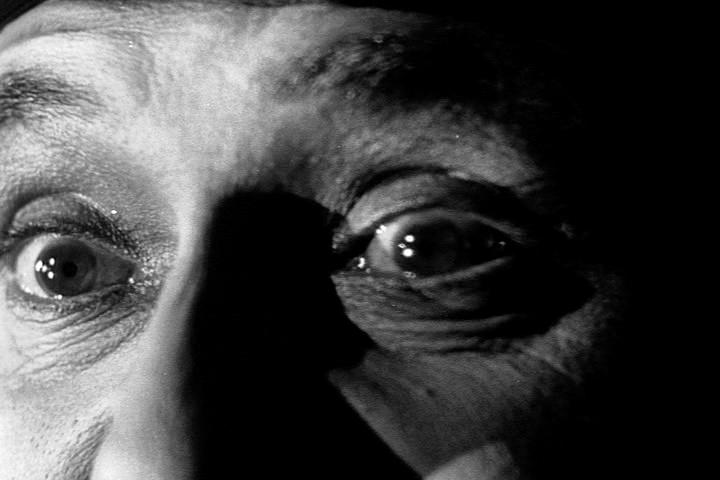
A narrator starts to tell a story off-camera: "One day, the children brought home a camera." It's a simple statement; it starts simply, with a man -- no, not a man: an actor. Images of the children with the camera are intercut with images of a nice gentleman with graying hair, shot with a video camera in medium shot. As he continues, however, the (video) camera starts to push forward, so that the man is in close-up when he announces something unexpected: "When you look at it in a cold light, photography is death."

Camera continues a fascinating interplay of images as the actor delivers a monologue about the "dangers" that the Camera proposes. The children matter-of-factly do all the tasks needed to make a movie: check lights, process film, measure the f-stop; these are all shot in a very matter-of-fact manner as well, with relatively "normal" lighting and camera distances. These are all in stark contrast to the images of the actor, who the video camera moves into shots so close that we as viewers feel uncomfortable. The actor appears unattractive, even sinister: the light from the windows appears too harsh, his eyebrows are thick and menacing. The actor is also edited in an odd manner: often, we are presented with jump cuts to sudden extreme close-ups of his eyes. The images are not necessarily horrific, yet the tone established throughout this piece is horrific.

In many ways, Camera is an interesting precursor to Cronenberg's 2005 feature film A History of Violence, which cannily comments on the movies in a similar way. In that film, scenes of violence and gore which would otherwise titillate the viewer are presented in a stark, cold manner than unnerves even the most seasoned viewers, making us question the very nature of the horror film genre. (One can argue he this is a common preoccupation for the director, also seen in eXistenZ, Naked Lunch and especially the brilliant Videodrome, which also featured Leslie Carlson, the actor featured here.) In Camera, Cronenberg does not present any gore and yet the whole film is structured to terrify. I particularly like this piece because the link between photography and death so clearly derives from Roland Barthes' tragically final work Camera Lucida. These ideas were not academic for Barthes: the work is inspired by his mother's death, and every photograph of her does not remind him of the joy that her life brought, but instead serves to mock him, reminding him that she is dead. Cronenberg highlights something very similar: the life captured by motion pictures only demonstrates that such moments cannot be repeated and taunt us with what once was and can never be again.

Camera becomes truly haunting in the last minute or so, when the children bring the large, old 35mm camera into the room with the actor. They apply make-up, change everything around and then a young boy (bespectacled, like Cronenberg) says, "Action." And suddenly, the image changes: it is warm, gorgeous, widescreen. And suddenly we realize that the harshness of everything that has come before is largely due to the use of video instead of film. (This section was actually filmed with the very camera seen throughout the short.) And yet, as soft and beautiful as this looks/sounds/feels, we are acutely aware of everything that the actor has noted before this. He repeats his initial line -- "One day, the children brought home a camera" -- but the line is changed, no longer innocent. And this time, the shot hangs on just a little too long. It catches the actor's face in a private moment: in the last seconds of the film, Carlson's face breaks for just a moment, his eyes watering and distant, filled with despair. The film cuts away to black -- and the effect is terrifying. Can we watch movies again the same way?

This entry is part of the Movies About Movies Blogathon hosted at GoatDogBlog -- please feel free to visit the other entries listed on that site. This is also cross-posted as the first entry at the newest incarnation of The Short Films Blog, the blog associated with my course this semester. New entries on short films will appear every day until December 11th, with students starting to post next weekend. Please visit there often -- and comment on the students' work, since they earn extra credit for more comments!

Thursday, May 29, 2008

Quietly, with Madeline

Many things will be said about the comic genius and fantastic, zippy presence of Madeline Kahn during Stinkylulu's Kahn-fest today. There will undoubtedly be a lot of wonderful commentary on her roles throughout her career; I hope, for one, that someone does a comparison of her Blazing Saddles singing with Marlene Dietrich's warbling in the westerns that she did.

For me, however, thinking about Madeline Kahn oddly comes back to Judy Berlin, a quiet wisp of a movie that happened to be her last. Her supporting role as a Lawn Guy Land mother, just realizing her marriage ain't what she thinks it is, is pitch-perfect.

I remember less about the film itself, however, and more about the experience watching it. I wanted to see it not only because it happened to win Sundance that year, but also because I heard both Madeline Kahn was fantastic in it. It was playing at a theater I had not really been to in downtown Monterey, California, right on the main drag. The only time that I had to see the movie was a matinee sometime during the week; in those days, I was mostly trying to finish my dissertation during the daytime and waiting tables at night, so movies had to get squeezed in by hook and crook sometimes. I remember racing to the theater, buying my ticket and walking in.

Upon entering, I realize that the space I've entered is somewhat cavernous: a relatively large theater for what is really a small town. There are only a few lights on, although maybe there was only one, as I only remember one, right above. The rest of the theater was curiously dark. My eyes adjusted to the darkness and I saw that I was in what had been a lovely old theater, with some wonderful details on the sides -- but that had been years ago. Fallen somewhat into disrepair, there were cracks on the ceiling in a number of places, some plaster on the floor somewhere. I saw it was a beautiful theater, if a bit sad in its manner of cracking.

And so began the movie: Judy Berlin. And quickly, before I get into the movie itself, I realize that I am alone in this grand old theater. It is, I think, the only time I have had such a privilege -- awkward, because this should have more viewers, because movie-watching is a social experience where we are collectively alone. And yet, also amusing and intimate. And so, when Madeline comes on the screen, I don't feel as if she is speaking only to me; she really is only speaking to me -- large, in black-and-white, wonderful, cracking.

This entry is part of Stinkylulu's Madeline Kahn Appeciation Day -- please visit the other sites on the list, since at least one of them is sure to bring up that fact that she was in possibly the best flick of 1979 The Muppet Movie.

Saturday, January 05, 2008

Best Supporting Actress, Class of 2007: Tabu

I have seen so few movies in theaters this year and, admittedly, many of them just happen to have great male supporting roles but not so many female ones. Really, I'm a huge fan of Cate Blanchett's turn in I'm Not There, even if I'm not that much of a fan of the film -- but that would be too easy. I also really enjoyed Kelly MacDonald's turn in No Country for Old Men, but that could have something to do with the accent.

The Namesake, however, seems to hinge on the character of Ashima, both in terms of the chronology which really begins and ends with her, and in terms of the narrative structure, since she really is the character that holds it together. And, though she is very well known in India, her presence in Nair's film is refreshing, yet grounded. Plus, as can be seen above, she can pull off girlish rebellion while wearing her future husband's spats. It's not quite the lead role in this very ensemble film, but it's the linchpin and the performance sticks.

For these reasons and more, I submit my candidate for Best Supporting Actress 2007: Tabu.

This entry is part of the 2nd Annual Supporting Actress Blogathon -- please feel free to visit the other sites on the list, since I know for sure they have probably seen more films than I have and the list is always fun and varied

Saturday, December 29, 2007

"Forget the Alamo"

The entry is part of the Endings Blog-a-Thon, featuring a variety of other blogs all talking about movie endings, which i find a fascinating subject. Thanks to Joe at Joe's Movie Corner for putting this all together.

And therefore, be forewarned that the very nature of this posting means here there be spoilers and please do not read unless you have seen the movie in question or don't mind the ending ruined.

Every semester that I teach the introductory film course, I pick a new slate of 14 movies to show over the course of the semester. Most of the students stay with me no matter what I teach, because, somehow, they trust me. Even the movies that confuse them -- Lucretia Martel's The Holy Girl (which I've written about before), Akira Kurosawa's Yojimbo (which I still don't understand why they don't like), Jean-Luc Godard's Breathless (their dislike for this also mystifies me, yet it's happened three times) -- are accepted.

All except one.

This is a still from the final scene in John Sayles' Lone Star, one of the most impressive movies I have seen about the contemporary American condition. Featuring a complex tapestry of storylines centering about the town of Perdido on the Texan border with Mexico, the film also openly deals with complicated concerns about history and how nothing is ever as simple as it seems. Unlike other films which tackle RACIAL CONCERNS!! with bolded, italicized, capital letters by arming itself with a sledgehammer of stereotypes (hello, Crash!), each person in Sayles' Lone Star is a full-fledged character, even if they only have a single scene.

The movie begins with the discovery of a sheriff's badge and a bullet on a skeleton right outside the town limits. This sends the current sheriff, Sam Deeds (played by Chris Cooper), on a quest to determine whether local hero and lauded sheriff Buddy Deeds -- who happens to be his father -- actually deserves his honor, or whether he killed a fellow sheriff in cold blood. In the process, he unearths many long-buried stories about how the white, black, Mexican and native populations have not-so-carefully gotten along in the interim and how times really have changed.

Add into the mix a rather interesting and tender romance between Sam and schoolteacher Pilar Cruz (Elizabeth Peña). We eventually learn that she is widowed with a teenage son, he is divorced, and that as teenagers themselves they were deeply in love. Torn apart when his father and her mother, a Mexican immigrant, find them hot and heavy at a drive-in, they are forbidden to see one another until now. As the rest of the story unfolds, Sam and Pilar's story seems like an interesting diversion. At one point, we are even offered a very steamy lovemaking scene between Sam and Pilar with Freddy Fender playing in the background.

If you've seen other Sayles films, you'll know that that scene is a bit out of character for him. Indeed, the love scene seems otherwise typical for any other film, shot in a very standard style. But most of Sayles' films don't deal with love in quite this way, so this stands out, even if it doesn't seem that problematic or consequential at the time.

It turns out to be very important. The last scene is very simple: Pilar drives up to the drive-in -- long since abandoned -- to meet Sam for the first time since they had their fling, the very drive-in where their parents separated them so many years ago. And while there, Sam shows her a picture of her parents. That is, a picture of her mother and his father. Yes: at the very end, she -- and we -- find out that his father had been having a secret affair with the Mexican immigrant who he helped save as she was crossing the border. And that what they though was merely their parents' racist attitudes covered a bigger fear: that they would find each other and commit incest instead. May I remind you of the sensuous love scene I described above?

Here is the kicker: she is completely overcome, not believing that after all this time of unrequited love, they are still thwarted. He holds her hand as they sit on the hood of his car.
Sam: If I met you today, I'd still want to be with you.
Pilar: We start from scratch?
Sam: Yeah.
Pilar: All that other stuff-- all that history... to hell with it, right? Forget the Alamo.
And the movie ends.

It's important to know that I usually end my screenings by having a discussion immediately following the credits. Students have usually taken this moment to chat with one another about it and I then offer them the ability to share with everyone what they think, a la 60s cinephilia.

Here's the thing: this is the only movie which hasn't worked well under such circumstances. Upon further reflection, students are able to process the subtle layering of the movie, how this one very quiet scene sends a corkscrew through every other part of the movie. It turns everything around and manages to force us as viewers to reflect on each element of the movie as it has built up. It's a different kind of twist than what we are used to in things like The Sixth Sense or The Usual Suspects, but those movie also allow us with at least a couple shots in a montage to show us just how the twist affects the movie. Lone Star makes us think that for ourselves, which we eventually do. As such, it's an extraordinary piece.

But this ending really messes up your average undergraduate's mind, where all they can think is oh mah gahd, he just slept with his SISTER!!! I mean, heck, Chinatown gave us more time to deal with that. The fact that these otherwise really cool, normal, nice characters not only learn that they have committed an ultimate transgression but that they resolve to be OK with it and keep going -- to "forget the Alamo" indeed -- is just too much to immediately process. Lone Star has an ending that demands thought and time and, as such, stands above many other contemporary films.

Saturday, July 07, 2007

¡Ay, Ninón!

I only just found out about this blog-a-thon, so I'm late on the scene; nonetheless, I was taken for a moment by the idea of "the performance that changed my life." Indeed, there are so many that I consider near and dear to my heart: Gene Kelly in Singin' in the Rain, Claude Rains in Casablanca, James Dean in Rebel without a Cause, Emily Watson in Breaking the Waves and (perhaps surprisingly) Arsinée Khanjian in Speaking Parts. I saw all of these for the first time (or at least seriously for the first time) either right after college or during graduate school and therefore during my formative period as a professional film geek; hence, all these are at least influential.

But which performance changed my life? That would probably be...

Ninón Sevilla as Elena Tejero in Aventurera

Ninón is not the best-known actress from the Golden Age of Mexican Cinema from the 1940s; indeed, she may not even be the best, considering that she would be competing with luminaries like María Félix and Dolores del Rio. But she's definitely got something. (She's the one in the center of the picture above. As if you could look anywhere else -- although yes, Miguel Inclán is one of the most amazing character actors ever.) In the cabaretera films (a genre which mixes the musical, the melodrama and film noir in a singularly Mexican way), Sevilla
was by far and above the best. In this film, she captivates the screen: defiant, sexual, sure of her destiny and her doom. She's fierce and she's fiesty and she wears pineapples on her head in one rump-shaking dance number.But why is this the performance that changed my life? Well, there are three extra-diegetic factors that contribute to this. For one, this is one of my favorite movies that I saw the first time I went to the Telluride Film Festival in 1994, back when I was an intern. Shown as a rediscovered classic (which had only recently been subtitled -- finally -- in English), the movie made an indelible impression that I couldn't shake for some time afterwards, as I had never seen anything like it before. Secondly, it helps that only a couple days after seeing the film, I actually had a long chat with the woman in a van ride back to Montrose, whereupon she became the first movie star I ever actually had a conversation with. (I almost fell out of the van when I realized who I was sitting next to -- and she was thrilled to finally speak Spanish with someone other than her translator.) Aged 73 then, she still had the fire and verve in her and was an immensely classy lady.

Finally, and this is the most important reason, I believe this is one of the very first Latin American films I had ever seen. That seems strange now, since I am now a film scholar who
specializes in Latin American cinema, but I was not really introduced to the region's cinema until my first semester of grad school, which happened immediately after this festival. By this point I knew I wanted to do something with Latin America and I knew I wanted to do something with film, but somehow I never realized the two could go together. Thus, the performance that carries this film was a starting point into what would eventually become my future. And for that, muchisimas gracias, doña Ninón.

Oh, and just in case you think I'm the only one who thinks she's amazing, I w
ill point out that in some research I did years ago, she is mentioned in Cahiers du Cinéma in the Christmas issue of 1953. The title of that piece demonstrates the company she kept: "Greta, Marlene, Ninon." Priceless.
This entry is part of the Performance That Changed My Life Blogathon -- please feel free to visit the other sites on the list at that site, particularly since they probably had more time to prepare and I'm late, heh. Thanks to Emma for putting all of this together!

Tuesday, June 12, 2007

¡Sí, soy trailera! (Action Heroine Blog-a-Thon entry)

I spent last weekend at a fantastic workshop in Edmonton, Alberta, learning all about the many different kinds of movies revolving around “Latsploitation” – i.e. Latin American exploitation films. I learned a heck of a lot about exploitation films in general (which frankly I knew very little about beforehand) and how Latin America in general fits within the context of the many “genres” of exploitation films. (For the record, my own contribution to this project is on Luis Llosa’s films made in Peru for Roger Corman’s Concorde-New Horizons pictures in the late 1980s, and how they might fit into current definitions of Peruvian national cinema. Also for the record: yes, I actually auditioned for one of these movies. No, I didn’t get the part. Yes, my high school English teacher is in the movie. Enough questions.)

It was also at this gathering that I was introduced to Lola la trailera.

Played by actress Rosa Gloria Chagoyán, “Lola the Truck Driver” is a super-sexy Mexican woman who inherits a big ol’ truck when her father is killed and she has to get to the bottom of things. In the process, she kicks some major ass and takes names. Seriously, she is a very different Mexican woman on screen than anything I had ever seen before: in a bar-room brawl, right after confirming on a date that “sí, soy trailera (yes, I am a trucker),” she smacks people on the head with a beer bottle instead of running away. These movies all take place on the Mexican-American border – part of a sub-genre of cheaply made, popular Mexican films derogatorily referred to as “cine churro” – and stress a different kind of nationalism than what we generally see from the likes of Alfonso Cuarón and Alejandro González Iñárritu (which actually Mexicans apparently don’t watch anyway – they do watch a lot of Lola, however). She succeeds in working against against narcotrafficking, foils her gringo nemeses and still looks good in a red mini-dress.

Honestly, I’ve only just been exposed to this myself, but I’m already smitten. One of the first things I did when the workshop ended was order a copy of the film Lola la trailera (1983) for my university so I can show clips for class. (Of her many films, it’s the only one subtitled so far.) What’s amazing is that apparently Lola-the-character has now turns the actress Chagoyán into something of a border activist herself. You’ll have to read more when this essay collection comes out sometime next year hopefully, with this article to be written by my colleague (and former advisor!) Catherine Benamou, who gave a fantastic presentation.

Thanks to YouTube (and some guy who apparently has a serious pantyhose-on-Mexican-women fetish), you can get some glimpses of what the big deal is about. Below are two pieces of what appears to be the same scene from Lola la trailera 3 from 1991; look for “Lola,” the actual truck that Lola drives, in the second clip. The other woman, by the way, is her madrina, or godmother.


Clip 1:


Clip 2:


This entry sends a big shout-out to Catherine Benamou (whose presentation inspired this posting), David Wilt (whose Mexican Film Resource Page provides a wealth of information), the Latsploitation Queens Vicki Ruetalo and Dolores Tierney (who put together the workshop and are organizing the larger project) and all the colleagues who I hung out with in Alberta last weekend. The entry is part of the 2007 Action Heroine Blog-a-Thon, featuring a variety of other blogs all talking about chicks on film who kick butt. Thanks again to Nathaniel at The Film Experience for putting this all together. Check this page for all the other participating blogs in this experience.

Saturday, January 06, 2007

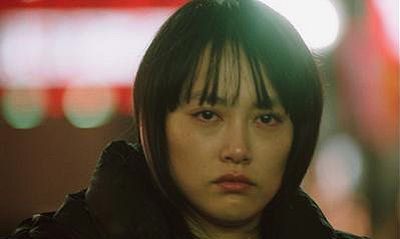
Best Supporting Actress, Class of 2006: Rinko Kikuchi


It helps that, of this large ensemble cast, she is the focus of the storyline that could easily stand on its own.

It helps that she convincingly plays someone who is deaf, even though she is not.

It helps that she manages to convey a panoply of emotions --rage, lust, empathy, hunger -- on her face and body, even when she has no clothes on, or when strobe lights flash all around her.

It helps that she is not a star (indeed, that we have never even heard of her before), that she is indeed acting.

It helps that, even if for me she is not part of the key "image" that I take from the film (that would be her competitor, the fine actress Adriana Barraza, who walks alone through the desert with the torn red party dress trailing behind her) that her performance is strong, convincing and indelible throughout the film, to the point that her face alone will not free you.

For these reasons and more, I submit my candidate for Best Supporting Actress 2006: Rinko Kikuchi.


This entry is part of the Supporting Actress Blogathon -- please feel free to visit the other sites on the list, particularly since they have probably seen more films than I have, heh heh.

Sunday, October 29, 2006

Drácula sounds much better with an accent (Vampire Blog-a-Thon)

Those eyes: terrible, desperate, yet exhilerating. They are haunted, haunting. And yet you can see how those eyes can hold you in their power, in their venerable thrall. The eyes of Dracula.

Well, not quite. They are, rather, the eyes of Drácula. Don't forget that accent; in Spanish, that would be a spelling mistake.

The coming of sound caused many problems for Hollywood in the late 1920s, but one of the biggest involved all those movie-goers south of the border: the exceptionally large Latin American market. Starting in 1930, Universal attempted to reach out to these patrons by filming many of their established hits with the same scripts now acted out by Spanish-speaking actors. (Indeed, the "Mexican spitfire" Lupe Vélez largely became a star through her lead roles in both the English and Spanish versions of 1930's East Is West and 1931's Resurrection.)

Only a handful of these films were made before 1931, but the most famous -- and certainly the only one of these films that is widely available -- is the curious case of Drácula. The Spanish version is largely the result of a cost-cutting measure executed by producer Carl Laemmle, Jr. to literally make two films at once: the English version, directed by Freaks auteur Tod Browning, would film in the daytime while the Spanish version, directed by George Melford (The Shiek), would film using the same script and sets that night. The Browning version catapulted star Bela Lugosi to international fame and is today considered a classic on its own terms.

Don't get me wrong: Lugosi's singular stare is the stuff made of legends and the man's debonaire interpretation of the Vampire-to-end-all-vampires is brilliant. As a movie, however, Drácula is far better.

I just finished watching both films at the same time, one on my television and the other on my computer and while both feature relatively similar scripts, the two are strikingly different. Lupita Tovar -- who plays "Eva" (not "Mina") and provides an introduction for the film for the recently produced multi-disc package done by Universal -- indicates that the actors even had the same blocking marks at night as the daytime English cast, but that means little when the camera is set up in a different place or is doing something very different. For example, one of the iconic shots of Lugosi comes early in the film when the camera slowly tracks into a close-up of Dracula's face, eyes highlighted by a band of very bright light. This happens to be the first time that we see him and it's a very effective shot. The Spanish version introduces Carlos Villarías simikarly but with no moving camerañ Melford saves it instead for an extremely impressive shot on the staircase when Renfield (played frenetically by Pablo Álvarez Rubio) sees him for the first time. Browning creeps us out with his magnificent moving shot -- but Melford puts us into Renfield's shoes in a far more effective manner by giving us a far more dynamic shot (shown here) when the narrative deserves it, not just because we should ooh and aah. In many ways, Drácula is also far more human than Dracula. Oddly enough, this is partially due to Villarías' hands, which are significantly smaller than the craws that Lugosi bends into shape. Mostly, however, the effect seems to come from how Melford frames Drácula and Renfield together as they interact rather than isolating them in individual (and isolating) shots.

But what about Eva? Ahh, here is where the real difference lies in the two pictures: the treatment of the woman. For all that she does in the English version, Helen Chandler plays Mina as cold and aristocratic, like most female roles of the time. In Stoker's novel, however, Dracula is far more sexual and the fact that mostly women fall under his thrall implies a certain explicit sexuality which is only implied in Browning's film.

Not so Melford's version. Freed from the binds of the fledgling Production Code, Melford was able to show much more of what Drácula does to Eva and, even if he doesn't show all-out sex, the evidence is far clearer. For one thing, the Melford version actually shows the bite marks as evidence to the viewer, something denied in the Browning version. And please: look at these images here. First, Eva is drawn to Drácula in the night. Helen Chandler would not be wearing the shapely, sheer dress with which Lupita Tovar saunters saucily onto the screen. Even from far away, we can see why Drácula wants her, not to mention what he wants her for. Of course, the implication here is that Eva wants it, too. This shot culminates, by the way, in Drácula lifting his cape and Eva coming under his wing, which he clearly brings down in order to "kiss" her on the neck. Yes, there is a lot of Eva-kissing in this film -- on the hand, on the neck, kiss-kiss everywhere. (Poor Mina never gets to have any fun in Browning's film.)

And just look at her after Drácula has finally had his way with her! Yowza. Doesn't she look like she's about to start singing "I Feel Pretty"? That's because she got some Drác blood in her! Tovar plays Eva in a far more carefree manner than Chandler throughout the film, but the looser attitude really comes across here with the plunging neckline, the loose devil-may-(literally)-care hair and a stance that says "I'm a WOMAN now!!" Her fiancé, Juan, says, "I can hardly believe it! You're a different woman now!" Guess what, bucko: she is. Maybe you should have gotten to her first. By showing us some of these scenes, Melford's version of the Stoker tale not only stays faithful to the novel with its implied sexual tension, but also simply makes much more sense. Give me Lupita Tovar any day... but only if she bites.

This posting is part of the 2006 Vampire Blog-a-Thon, featuring over 40 other blogs all talking about vampire movies. Thanks to Nathaniel at The Film Experience for putting forth the idea! Check this page for information on all the other blogs, although I particularly like these:
Oh yeah -- and Happy Halloween!

Friday, October 20, 2006

Because there's just not enough blood in the world


Tune in on the 30th. I was tempted to do another riff on Buffy but, considering I've already done that (and professionally, even), I'm aiming for something more classic. (Or, more appropriately, más clásico.)

And no, Xan is not going trick-or-treating as a vampire. There is a costume, which we will try out this weekend, I think. And we have pumpkin. And we have a Costco-sized bag o' candy (because if you have it, they won't come, and if you don't have it, they will...with eggs...). Now we just need him to beg for more candy for us.